
Activism
OP-ED: Slogans Over Solutions: The Real Cost of Defunding the Police
Let’s be blunt: Defund the Police is not just a failure—it’s a farce. Consider Oakland’s much-hyped MACRO program, designed to respond to 911 calls without armed officers. In theory, it was supposed to lighten the police’s load and ensure that non-violent incidents were handled by social workers. In practice, it’s a bureaucratic disaster. Nearly all of its service recipients are homeless, and a mere 6% of calls result in meaningful help. The cost to taxpayers? Nearly $3,000 per referral.


By Dr. Jennifer Tran
It’s time to cut through the slogans and set the record straight on the “Defund the Police” movement. What started as a rallying cry, borne out of real pain and injustice, has become a case study in misguided policy, political opportunism, and unintended consequences. It is, in fact, a lesson in the tragic comedy of American politics, where grand gestures replace practical solutions, and the impulsive dreams of self-serving politicians only succeed in plunging cities into chaos. And the communities that were supposed to benefit from these reforms? They’re the ones paying the steepest price.
To understand how we got here, let’s rewind the tape to 2013, when the Black Lives Matter (BLM) movement emerged in response to horrific instances of police brutality. The deaths of Black men and women at the hands of law enforcement rightly shocked the public, and for once, there was a reckoning with the systemic inequities that had long plagued the American criminal justice system. It wasn’t just theory anymore, buried in the pages of university texts. Viral videos of police brutality turned those academic arguments into raw, painful reality for millions. People were outraged, and rightly so. We demanded change.

Then came 2016, when Oakland’s Anti-Police Terror Project decided the solution to police violence was to cut the police budget by 50%. In a utopia where crime doesn’t exist, maybe that could work. But on the streets of America, where real people face real threats, the idea was nothing short of delusional. The group, bankrolled by millions from the Akonadi Foundation and its president Lateefah Simon, pushed to slash Oakland’s police budget in half and divert the funds to social services. Sounds noble in theory. A better society, they promised, lay just beyond the horizon—one where cops were obsolete and violence simply evaporated once social workers entered the scene. But there’s a reason serious policy experts dismissed this as fringe from the start—it was.
And then, the murder of George Floyd in 2020 gave this once-fringe movement a national megaphone. “Defund the Police” became the rallying cry for protests that swept across the country. City councils from Oakland to New York City fell over themselves to slash police budgets in response to activist pressure. Progressive politicians saw an opportunity to appease their activist base by passing “bold” policies, irrespective of the practical consequences.
But herein lies the rub. Defunding the police is not a policy—it’s a moral pose, an empty chant masquerading as a solution. What exactly did anyone think would happen when cities with already strained police forces began gutting their budgets? Did they think crime would simply cease? That communities terrorized by violence would find comfort in knowing that more mental health workers were on call while fewer officers patrolled their neighborhoods?
The reality struck like a hammer. When police officers, demoralized by public scorn and abandoned by their city leaders, began resigning in droves, crime spiked. Homicides, carjackings, and robberies surged in cities like Oakland, while the communities that supposedly stood to benefit from defunding were left more vulnerable than ever. In fact, it became clear that the only people who thrived in this brave new world were the criminals.
What’s worse, the political damage was catastrophic. Not only did the Defund movement fail to deliver on its promises, but it handed Republicans a golden opportunity to paint Democrats as reckless and soft on crime. In the 2020 elections, the backlash was evident as Democrats struggled to shake off the taint of these disastrous policies. What could have been a serious conversation about police reform—about how to make law enforcement both effective and accountable—was hijacked by the extremists who would rather tear it all down.
Let’s be blunt: Defund the Police is not just a failure—it’s a farce. Consider Oakland’s much-hyped MACRO program, designed to respond to 911 calls without armed officers. In theory, it was supposed to lighten the police’s load and ensure that non-violent incidents were handled by social workers. In practice, it’s a bureaucratic disaster. Nearly all of its service recipients are homeless, and a mere 6% of calls result in meaningful help. The cost to taxpayers? Nearly $3,000 per referral.
Meanwhile, Oakland’s police force remains understaffed, overburdened, and demoralized. Despite budget reversals in 2022, the damage was done. Many officers, tired of being vilified, left the force altogether. And now, the city is struggling to recruit replacements while crime rates continue to climb.
But rather than learn from failure, the Defund movement doubled down. When reducing police numbers didn’t deliver the utopia they’d promised, they shifted their focus to local district attorneys, funding campaigns for candidates who promised to stop prosecuting crimes altogether. The result? A crime wave unlike anything we’ve seen in years. Retail theft, carjackings, burglaries—if there’s a crime to commit, it’s being committed in cities where these “progressive” prosecutors are in charge.
And in Oakland, the epicenter of this failed experiment, District Attorney Pamela Price is now facing a recall. Why? Because the voters who once supported her are now living with the consequences of her policies. They know what happens when ideology collides with reality—and reality always wins.
Yet despite all of this, the architects of this movement are still trying to sell us their snake oil. Lateefah Simon, the financier and architect behind the entire movement to Defund the Police, is now running for Congress. Backed by the same billionaire funders who helped launch the Defund debacle, she’s hoping to take her failed ideas to Washington, D.C. And if we’re not careful, she just might succeed.
But there is a better way. I support a new and bold piece of legislation called the Modern Cities Act, which offers a sensible alternative. Instead of gutting the police, we need to invest in police departments to reform them. Under this plan, we can have both public safety and justice. This approach recognizes that we need mental health services, housing solutions, and job programs to address the root causes of crime, but we also know that without police, those programs won’t have a chance to succeed. Reforming police practices doesn’t mean getting rid of police—it means holding them accountable while making sure they have the resources and training to protect our communities while never endangering community members.
The truth is, we don’t need fewer cops. We need better cops. We need training, transparency, and yes, accountability. But the notion that we can simply defund the police into oblivion and expect society to flourish is not just naive—it’s dangerous. We should be questioning the judgment of any politician who ever supported this harmful experiment, and they should never be allowed in public office again.
So, the next time someone tells you that defunding the police is the path to progress, ask them this: who’s going to keep your family safe when the police are gone? And then ask them if they’ve learned anything from Oakland. Because the rest of us certainly have.
Dr. Jennifer Tran is a Professor of Ethnic Studies at California State University. She is also the President of the Oakland Vietnamese Chamber of Commerce, and Democratic Party candidate for US Congress in Oakland’s District 12. This article was sponsored by the campaign of Dr. Jennifer Tran for Congress.







Activism
Oakland Post: Week of March 18 – 24, 2026
The printed Weekly Edition of the Oakland Post: Week of March 18 – 24, 2026

To enlarge your view of this issue, use the slider, magnifying glass icon or full page icon in the lower right corner of the browser window.
Activism
Oakland Post: Week of March 11 -17, 2026
The printed Weekly Edition of the Oakland Post: Week of March 11 – 17, 2026
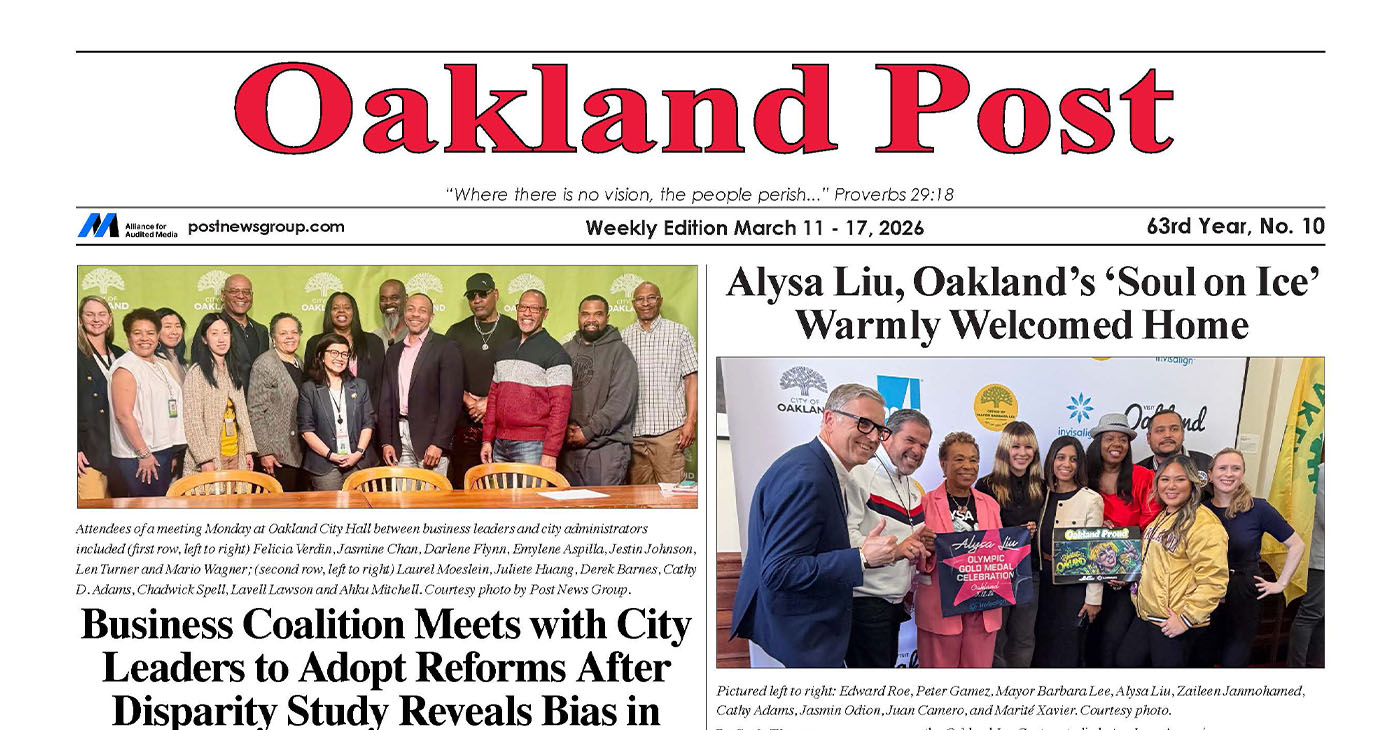
To enlarge your view of this issue, use the slider, magnifying glass icon or full page icon in the lower right corner of the browser window.
Activism
Oakland Post: Week of March 4 – 10, 2026
The printed Weekly Edition of the Oakland Post: Week of March 4 – 10, 2026

To enlarge your view of this issue, use the slider, magnifying glass icon or full page icon in the lower right corner of the browser window.

WORK FROM HOME
Home-based business with potential monthly income of $10K+ per month. A proven training system and website provided to maximize business effectiveness. Perfect job to earn side and primary income. Contact Lynne for more details: Lynne4npusa@gmail.com 800-334-0540


Black Artists in America, Installation Three Wraps at the Dixon Gallery and Gardens

Grief, Advocacy, and Education: A Counselor Reflects on Black Maternal Health

Future of Florida’s Black History Museum in Limbo

New Research Shows the Many Benefits of Early Learning

South Hampton K-8 Students Among Top 10 Finalists for Samsung’s ‘Solve for Tomorrow’ Competition

Cuba: No Negotiation with US on the President or Political System

Brooklyn Academy of Music Names Jamaican-Born Tamara McCaw as President

Trinidad & Tobego – U.S. Launches WhatsApp Channel for American Citizens in the Country

Oakland Post: Week of March 18 – 24, 2026

AI Innovation vs. Ethics and Environmental Impact

AI, Web3, and Digital Reparations

What If You Owned Your AI Agent?

Season 7, Episode 3 – January Reporter’s Roundtable 📱

Season 7, Episode 3 – January Reporter’s Roundtable

AI, Media, and Power | Part 2, Real-World Impacts and Tradeoffs

Book Review: Books on Black History and Black Life for Kids

California Launches Study on Mileage Tax to Potentially Replace Gas Tax as Republicans Push Back

Community Celebrates Turner Group Construction Company as Collins Drive Becomes Turner Group Drive

Discrimination in City Contracts

COMMENTARY: The Biases We Don’t See — Preventing AI-Driven Inequality in Health Care

Black History Events in the East Bay

Post Newspaper Invites NNPA to Join Nationwide Probate Reform Initiative

Art of the African Diaspora Celebrates Legacy and Community at Richmond Art Center

New Bill, the RIDER Safety Act, Would Support Transit Ambassadors and Safety on Public Transit

COMMENTARY: The National Protest Must Be Accompanied with Our Votes

Oakland Post: Week of February 4 – 10, 2026

Oakland Post: Week of February 11 – 17, 2026

Dorothy Lee Bolden: Uniting Domestic Workers

After Don Lemon’s Arrest, Black Officials Raise Concerns About Independent Black Media

Reflecting on Black History Milestones in Birmingham AL

Hyundai Ioniq 5 Parking, Safety, and 360 View #shorts

2025 Ioniq 5 New Wiper & Powerful Performance! #shorts

Electric SUV Range: Is 259 Miles Enough? #shorts

EV Charging: How Fast Can You Charge an Electric Vehicle? #shorts

Biometric Cooling… Messaging Seats…Come on! 2025 Infiniti QX80 Autograph 4WD

Charged Up: Witness the Magic of a Fully Electric Car! #shorts

Range Rover Sport PHEV Included…: See What’s Inside This Luxury SUV! #shorts

Invisible Hood View: Perfect Parking with X-Ray Vision! #shorts

AI Is Reshaping Black Healthcare: Promise, Peril, and the Push for Improved Results in California

ESSAY: Technology and Medicine, a Primary Care Point of View

Sanctuary Cities

The RESISTANCE – FREEDOM NOW

STATE OF THE PEOPLE: Freddie

ECONOMIC BOYCOTT DAY!!!!!

I told You So
-
 #NNPA BlackPress4 weeks ago
Reflecting on Black History Milestones in Birmingham AL
-
 #NNPA BlackPress4 weeks ago
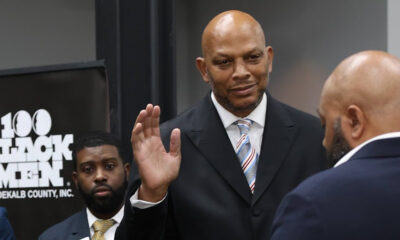
PRESS ROOM: NBA Hall of Fame Nominee Terry Cummings Joins 100 Black Men of DeKalb County to Launch Victory & Values Initiative
-

 #NNPA BlackPress4 weeks ago
U.S. manufacturing rebounds – how foundry services are adapting to rising demand
-

 Activism3 weeks ago
Oakland Post: Week of February 25 – March 3, 2026
-

 #NNPA BlackPress4 weeks ago
Trump’s MAGA Allies are Creating Executive Order Plan to Steal the 2026 Midterms
-

 #NNPA BlackPress4 weeks ago
OP-ED: One Hundred Years of Black Workers Telling the Truth
-

 #NNPA BlackPress4 weeks ago
Advancements in solar technology that are changing the way we power the world
-
 #NNPA BlackPress4 weeks ago
PRESS ROOM: Civil Rights TV Launches in Selma as the World’s First 24/7 Civil Rights Television Network
