
Bay Area
Oakland NAACP Demands Investigation on Missed Deadline for Crime Fighting Funds from State
On Monday morning, community leaders including representatives from the Oakland NAACP chapter held a press conference at Acts Full Gospel Church to discuss their response to the city’s failure to meet the deadline for applying for state funding aimed at tackling organized retail crime.

By Magaly Muñoz
Post Staff
On Monday morning, community leaders including representatives from the Oakland NAACP chapter held a press conference at Acts Full Gospel Church to discuss their response to the city’s failure to meet the deadline for applying for state funding aimed at tackling organized retail crime.
Last year Gov. Gavin Newsom signed Senate Bills 154 and 178 introduced by Sen. Nancy Skinner (D-Alameda) allocating a total of $267,118,293 to fight organized retail crime, the largest-ever single investment by the state.
On Sept. 14, the Board of State and Community Corrections (BSCC) awarded grants from the state budget to 55 local law enforcement agencies across California as part of the Governor’s Real Public Safety Plan. These grants, aimed at preventing, investigating, and prosecuting cases of organized retail theft, will be distributed among 34 police departments, 7 sheriff’s departments, one probation department, and 13 district attorney offices.
The application for the awards opened on April 14 and were due by July 7 at 5 p.m. (PST) through an online submission port.
In the Bay Area, law enforcement grants were awarded to San Francisco ($17.3 million), Fremont ($2.4 million), Newark ($986,444), Vacaville ($4.4 million), Santa Rosa ($560,653) and San Ramon ($5.6 million). In addition, $2 million in grants were awarded to the Alameda County District Attorney and San Francisco District Attorney.

Had Oakland made the application deadline, NAACP estimates that it could have received about $15 million for “extra police patrols, squad cars, and automated license plate readers to track down suspected perpetrators of crime.”
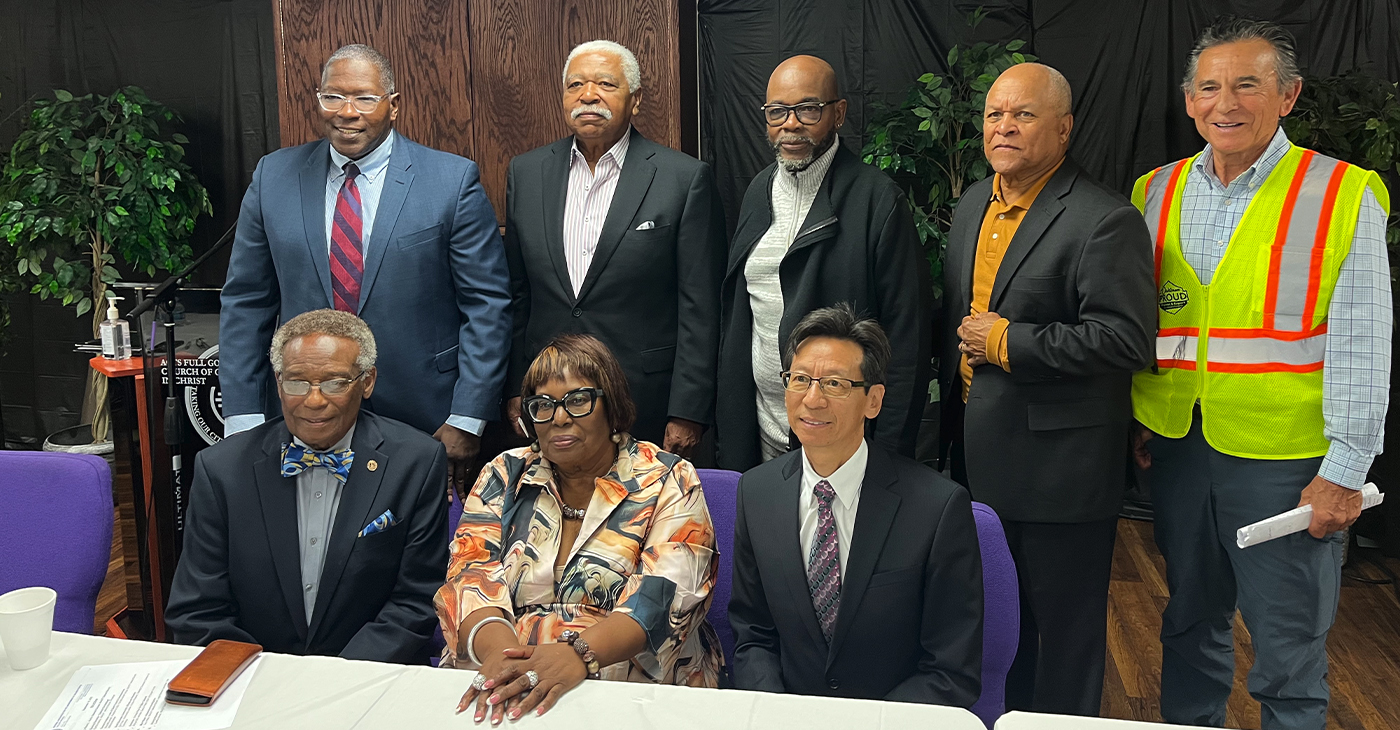
Participating on the press conference panel from the Oakland NAACP branch were Robert L. Harris, general counsel; Cynthia Adams, chapter president; Greg McConnell, lifetime member; Terry Whiley, legal redress committee chair; and representing the community was Carl Chan, former president of Oakland Chinatown Chamber of Commerce; Bishop Bob Jackson, senior pastor at Acts Full Gospel Church; and Noel Gallo, Oakland city councilmember.
The panel said they don’t fully believe that the city accidentally missed the grant deadline, but just didn’t care to complete the application for unknown reasons that should be shared with the community. This has prompted the NAACP to ask for an independent investigation by the city auditor.
“Why wasn’t the application for a $15 million grant to fight retail theft not given the highest priority by the city administrator’s office?” Terry Wiley, a former district attorney with Alameda County, calling for an investigation.
Along with calling for an investigation, the NAACP announced a 10-point plan that they believe will create a safer environment in Oakland.
The points include ensuring 911 centers are fully staffed, installing surveillance cameras and license plate readers, implementing community policing strategies, and increasing the staff of the Oakland PD to 1,000 officers. The plan also proposes rehiring of former police chief LeRonne Armstrong, who was dismissed in February by Mayor Sheng Thao over allegations of mishandling officer misconduct cases.
Chan told the audience that the city’s ongoing crime spree has prompted business closures, as workers and community feel unsafe, deterring them from supporting local businesses.
“It’s pretty sad to see that many businesses are suffering, along with people, whether they’re driving down on the street, carjacking or home invasion,” Chan said. “Many of our seniors are afraid of walking down our own streets, and it’s not right, it’s not fair.”
Because of these business closures, Chan announced plans for a one-day strike by Oakland’s small businesses to signal to the city that “enough is enough” and more action is needed against retail crime.
The panel also shared that Mayor Thao has repeatedly declined to meet with the NAACP Oakland chapter to discuss their concerns and proposed plans to combat the crimes in the city.
ABC7 reported that in a press conference at Oakland Airport on Monday, the mayor said she thinks it’s “utter BS” and “not true at all” that the city did not want to apply for the grant. She said that the city will be receiving 300 surveillance cameras from the governor’s office and are looking to start launching large drones to track down perpetrators, awaiting the FAA’s approval.
Adams concluded the press conference by demanding a statement and an apology from the mayor for neglecting to apply for a state grant that could have benefited the Oakland community.
“What is going on in Oakland is a civil rights issue,” Adams said. “The buck stops with the mayor. This is the mayor’s fault. We need to hear a statement, we need to hear an apology from the mayor for what she did to the citizens of Oakland.”








Activism
Oakland Post: Week of March 18 – 24, 2026
The printed Weekly Edition of the Oakland Post: Week of March 18 – 24, 2026


To enlarge your view of this issue, use the slider, magnifying glass icon or full page icon in the lower right corner of the browser window.

Activism
Oakland Post: Week of March 11 -17, 2026
The printed Weekly Edition of the Oakland Post: Week of March 11 – 17, 2026
To enlarge your view of this issue, use the slider, magnifying glass icon or full page icon in the lower right corner of the browser window.
Activism
Oakland Post: Week of March 4 – 10, 2026
The printed Weekly Edition of the Oakland Post: Week of March 4 – 10, 2026

To enlarge your view of this issue, use the slider, magnifying glass icon or full page icon in the lower right corner of the browser window.

WORK FROM HOME
Home-based business with potential monthly income of $10K+ per month. A proven training system and website provided to maximize business effectiveness. Perfect job to earn side and primary income. Contact Lynne for more details: Lynne4npusa@gmail.com 800-334-0540


Black Artists in America, Installation Three Wraps at the Dixon Gallery and Gardens

Grief, Advocacy, and Education: A Counselor Reflects on Black Maternal Health

Future of Florida’s Black History Museum in Limbo

New Research Shows the Many Benefits of Early Learning

South Hampton K-8 Students Among Top 10 Finalists for Samsung’s ‘Solve for Tomorrow’ Competition

Cuba: No Negotiation with US on the President or Political System

Brooklyn Academy of Music Names Jamaican-Born Tamara McCaw as President

Trinidad & Tobego – U.S. Launches WhatsApp Channel for American Citizens in the Country

Oakland Post: Week of March 18 – 24, 2026

AI Innovation vs. Ethics and Environmental Impact

AI, Web3, and Digital Reparations

What If You Owned Your AI Agent?

Season 7, Episode 3 – January Reporter’s Roundtable 📱

Season 7, Episode 3 – January Reporter’s Roundtable

AI, Media, and Power | Part 2, Real-World Impacts and Tradeoffs

Oakland Post: Week of February 11 – 17, 2026

Reflecting on Black History Milestones in Birmingham AL

CITY OF SAN LEANDRO STATE OF CALIFORNIA PUBLIC WORKS DEPARTMENT ENGINEERING DIVISION NOTICE TO BIDDERS FOR ANNUAL STREET OVERLAY/REHABILITATION 2019-21 – PHASE III

Oakland Post: Week of February 18 – 24, 2026

PRESS ROOM: NBA Hall of Fame Nominee Terry Cummings Joins 100 Black Men of DeKalb County to Launch Victory & Values Initiative

Oakland Post: Week of February 25 – March 3, 2026

Trump’s MAGA Allies are Creating Executive Order Plan to Steal the 2026 Midterms

U.S. manufacturing rebounds – how foundry services are adapting to rising demand

OP-ED: One Hundred Years of Black Workers Telling the Truth

Advancements in solar technology that are changing the way we power the world

Chase Oakland Community Center Hosts Alley-Oop Accelerator Building Community and Opportunity for Bay Area Entrepreneurs

Poll Shows Support for Policies That Help Families Afford Child Care

Oakland Post: Week of March 4 – 10, 2026

PRESS ROOM: Civil Rights TV Launches in Selma as the World’s First 24/7 Civil Rights Television Network

Ghana Mourns a Son of the African World

Hyundai Ioniq 5 Parking, Safety, and 360 View #shorts

2025 Ioniq 5 New Wiper & Powerful Performance! #shorts

Electric SUV Range: Is 259 Miles Enough? #shorts

EV Charging: How Fast Can You Charge an Electric Vehicle? #shorts

Biometric Cooling… Messaging Seats…Come on! 2025 Infiniti QX80 Autograph 4WD

Charged Up: Witness the Magic of a Fully Electric Car! #shorts

Range Rover Sport PHEV Included…: See What’s Inside This Luxury SUV! #shorts

Invisible Hood View: Perfect Parking with X-Ray Vision! #shorts

AI Is Reshaping Black Healthcare: Promise, Peril, and the Push for Improved Results in California

ESSAY: Technology and Medicine, a Primary Care Point of View

Sanctuary Cities

The RESISTANCE – FREEDOM NOW

STATE OF THE PEOPLE: Freddie

ECONOMIC BOYCOTT DAY!!!!!

I told You So

-
 #NNPA BlackPress4 weeks ago
Poll Shows Support for Policies That Help Families Afford Child Care
-
 Activism3 weeks ago
Oakland Post: Week of March 4 – 10, 2026
-

 #NNPA BlackPress3 weeks ago
Woman’s Search for Family’s Roots Leads to Ancestor John T. Ward – A Successful Entrepreneur and Conductor on the Underground Railroad
-

 #NNPA BlackPress4 weeks ago
OP-ED: NNPA Launches 2026 “Leadership Matters” Video Series
-

 #NNPA BlackPress3 weeks ago
Advocates Raise Alarm Over ICE Operation, MOU and Detention Risks in Baltimore County
-

 #NNPA BlackPress3 weeks ago
COMMENTARY: Women of Color Shape Our Past and Future
-

 #NNPA BlackPress3 weeks ago
Pete Buttigieg to Join Mayor Randall Woodfin for Community Town Hall in Birmingham
-
 Activism2 weeks ago
Oakland Post: Week of March 11 -17, 2026
