
Business
GM Highlights Diversity at Detroit Auto Show


Ed Welburn, vice president of Global Design for General Motors, talks about the Avenir, Buick’s concept sedan at the Buick Global Reveal Event in Detroit, Mich. (Freddie Allen/NNPA)
By Freddie Allen
Senior Washington Correspondent
DETROIT (NNPA) – During the media week leading up to the 2015 North American International Auto Show, General Motors (GM) not only revealed new models and concept cars like other automakers, they also showcased the importance of diversity in the company’s ranks.
At “Design by Detroit,” an event hosted by GM that featured local artists, industry insiders and a custom-painted Stingray, three young, minority designers shared their experiences working for the embattled, century-old auto company.
Ven Lai, the lead creative designer for the Chevrolet Color and Trim Studio, said that after joining GM in 2007, she learned that the company appreciated passion for design and that when artists from different cultures and backgrounds lend their input to the process, the car, the customer and the brand benefit.
Crystal Windham, the first African American female design director at GM, currently leads the Chevrolet Passenger Car & Small Crossover Interiors department. Windham’s work was featured in the 2014 Chevrolet Impala and the all-new electric hybrid Chevrolet Volt.

“As designers, we’ve been empowered,” said Windham in her official press bio. “There is an exciting renaissance at GM and I am thrilled to be a part of it.”
Martin Davis, the design manager for the Exterior lighting and North American exterior Design, said that Windham has already left her mark on the interior design of Chevrolet passenger cars and that consumers will see even more of her influence on that segment very shortly as new products are rolled out.
Davis, who led the team that redesigned the exterior lighting for the new Cadillac Escalade said that working on the iconic sports utility vehicle was humbling and surreal.
“But you quickly get past that and embrace the challenge,” said Davis, who started his career with GM when he was 22 years old. “Working with new technologies like [light emitting diodes] enables us to do a number of things we haven’t done before.”
Davis continued: “There’s always that risk of being able to deliver on a design that you have sold to senior leadership and they are expecting your design to work.”
Ed Welburn, vice president of Global Design and General Motors, said that he still loves the look on a designer’s face when their concept is selected for a new project.
“I don’t care if they’re right out of school or if they’ve been with the company 40 years,” Welburn smiled. “They have that look on their face like they’re 8 years old.”
Welburn, who studied sculpture and design at Howard University and joined the automaker when President Richard Nixon was still in the White House, is the first executive to lead all of the company’s Global Design Centers in the United States, Germany, Korea, China, Australia, Brazil and India. The GM veteran said that he enjoyed knitting together a global team of studios, where everyone really knows and supports one another.
“It helps us understand our customers a whole lot better. Everyone brings some creative thought to the process that may be a bit unique in one way or another,” said Welburn. “I think we really benefit from that.”
Like cultural diversity overseas, Welburn said gender and ethnic diversity in the United States is extremely important to GM and considers his involvement in the evolving diversity mission at GM a part of his legacy. He admitted that there are not nearly as many Blacks and other minorities in the company as he would like.
Welburn met with the president of the College for Creative Studies in Detroit, Mich., and learned that the school was also having a tough time enrolling African American students.
Recruiting Blacks for STEM (Science, Technology, Engineering and Mathematics) careers isn’t just a GM problem, it’s an American one.
A 2014 study on STEM workers by the Joint Center for Political and Economic Studies, a nonpartisan think tank focused on racial equity, reported that Blacks account for less than 4 percent of workers in science and engineering jobs. Meanwhile, industries that are more dependent on STEM-related workers are expected to grow at nearly twice the rate as sectors that are less dependent on STEM workers.
That’s why the decorated auto exec is working with Detroit-area middle school and high school students, mostly African American, to identify the ones who want to attend CCS and offers them scholarships.
Anita Burke, the chief engineer of the GMC Canyon, a mid-sized truck, said that when she was younger, women didn’t go into design or engineering. That was considered men’s work. Burke thought about going into nursing or teaching, because that is what people expected her to do.
A chance conversation with a chemistry teacher who noticed her aptitude for math and science during her junior year in high school and encouragement from an older brother steered her away from nursing and into engineering.
“One of the things I’ve taken most from my career at General Motors is my best experiences have come when I stepped out of my comfort zone,” said Burke.
Burke took on two international assignments during her tenure at GM. She spent about three years in Toluca, Mexico and three and half years in Sao Paulo Brazil managing engineering groups and directing aftersales engineering.
“It was something I never would have imagined that I was going to do with my career coming out of college,” said Burke, a graduate of the Illinois Institute of Technology. “That was my first step out of my comfort zone and I learned from that, ‘Wow, the best things come from those [experiences].’”
Burke added: “If I didn’t step out of my comfort zone, I wouldn’t be chief engineer of this truck and it’s been my dream job.”
Burke said that it’s not only important that young women and minorities feel empowered to pursue STEM degrees, but that they also feel welcomed to pursue STEM careers. That’s the only way that the auto industry and many others will start viewing their presence in science and math fields as the norm.
“Many kids these days have zero understanding of what the auto industry is and depth of the things that you can do,” said Burke.
She explained, “You don’t have to be a CEO of a company, if that’s really not your passion, you just gotta love what you do.”
Welburn agreed.
“You can have a wonderful very fulfilling career in design,” said Welburn. “But the most important thing for me – I think it’s true for every young person – you need to go into a field that you’re passionate about whether its design or music or journalism. If you’re not passionate about it, don’t do it.”
###











Activism
Oakland Post: Week of March 18 – 24, 2026
The printed Weekly Edition of the Oakland Post: Week of March 18 – 24, 2026

To enlarge your view of this issue, use the slider, magnifying glass icon or full page icon in the lower right corner of the browser window.
Advice
Financial Wellness and Mental Health: Managing Money Stress in College
While everyone’s financial situation is unique, several common sources of stress have the potential to strain your financial health. These include financial and economic uncertainty, existing debts, unexpected expenses, and mental or physical health changes. Financial stress may differ from situation to situation, but understanding the factors contributing to yours may help you begin to craft a plan for your unique circumstances.

Sponsored by JPMorganChase
As a college student, managing financial responsibilities can be stressful.
If you’ve found yourself staying up late thinking about your finances or just feeling anxious overall about your financial future, you’re not alone. In one survey, 78% of college students who reported financial stress had negative impacts on their mental health, and 59% considered dropping out. While finances can impact overall stress, taking steps to manage your finances can support your mental, emotional and physical well-being.
When it comes to money, the sources of stress may look different for each student, but identifying the underlying causes and setting goals accordingly may help you feel more confident about your financial future.
Consider these strategies to help improve your financial wellness and reduce stress.
Understand what causes financial stress
While everyone’s financial situation is unique, several common sources of stress have the potential to strain your financial health. These include financial and economic uncertainty, existing debts, unexpected expenses, and mental or physical health changes. Financial stress may differ from situation to situation, but understanding the factors contributing to yours may help you begin to craft a plan for your unique circumstances.
2. Determine your financial priorities
Start by reflecting on your financial priorities. For students this often includes paying for school or paying off student loans, studying abroad, saving for spring break, building an emergency fund, paying down credit card debt or buying a car. Name the milestones that are most important to you, and plan accordingly.
3. Create a plan and stick to it

While setting actionable goals starts you on the journey to better financial health, it’s essential to craft a plan to follow through. Identifying and committing to a savings plan may give you a greater sense of control over your finances, which may help reduce your stress. Creating and sticking to a budget allows you to better track where your money is going so you may spend less and save more.
4. Pay down debt
Many students have some form of debt and want to make progress toward reducing their debt obligations. One option is the debt avalanche method, which focuses on paying off your debt with the highest interest rate first, then moving on to the debt with the next-highest interest rate. Another is the debt snowball method, which builds momentum by paying off your smallest debt balance, and then working your way up to the largest amounts.
5. Build your financial resilience
Some financial stress may be inevitable, but building financial resilience may allow you to overcome obstacles more easily. The more you learn about managing your money, for instance, the more prepared you’ll feel if the unexpected happens. Growing your emergency savings also may increase resilience since you’ll be more financially prepared to cover unexpected expenses or pay your living expenses.
6. Seek help and support
Many colleges have resources to help students experiencing financial stress, like financial literacy courses or funds that provide some assistance for students in need. Talk to your admissions counselor or advisor about your concerns, and they can direct you to sources of support. Your school’s counseling center can also be a great resource for mental health assistance if you’re struggling with financial stress.
The bottom line
Financial stress can affect college students’ health and wellbeing, but it doesn’t have to derail your dreams. Setting smart financial goals and developing simple plans to achieve them may help ease your stress. Revisit and adjust your plan as needed to ensure it continues to work for you, and seek additional support on campus as needed to help keep you on track.
JPMorgan Chase Bank, N.A. Member FDIC
© 2026 JPMorgan Chase & Co.
Activism
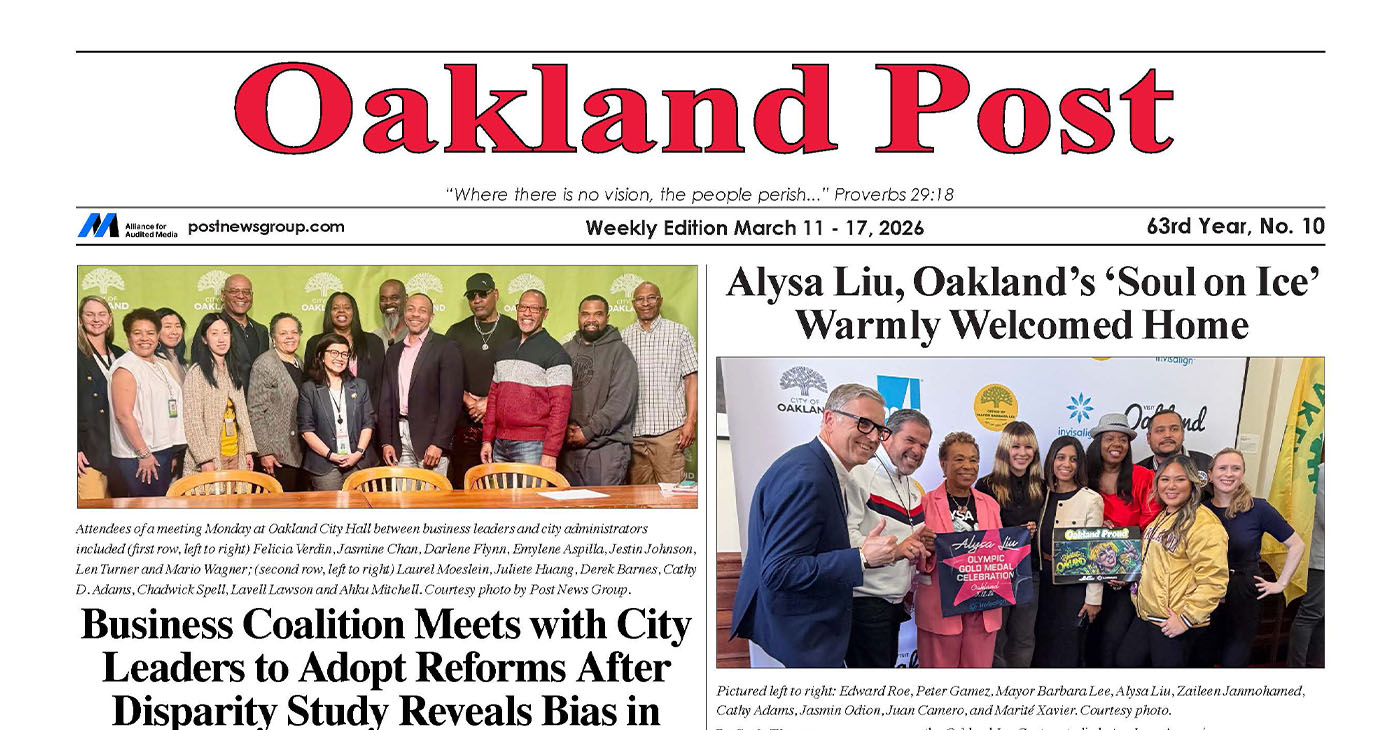
Oakland Post: Week of March 11 -17, 2026
The printed Weekly Edition of the Oakland Post: Week of March 11 – 17, 2026
To enlarge your view of this issue, use the slider, magnifying glass icon or full page icon in the lower right corner of the browser window.


WORK FROM HOME
Home-based business with potential monthly income of $10K+ per month. A proven training system and website provided to maximize business effectiveness. Perfect job to earn side and primary income. Contact Lynne for more details: Lynne4npusa@gmail.com 800-334-0540


Black Artists in America, Installation Three Wraps at the Dixon Gallery and Gardens

Grief, Advocacy, and Education: A Counselor Reflects on Black Maternal Health

Future of Florida’s Black History Museum in Limbo

New Research Shows the Many Benefits of Early Learning

South Hampton K-8 Students Among Top 10 Finalists for Samsung’s ‘Solve for Tomorrow’ Competition

Cuba: No Negotiation with US on the President or Political System

Brooklyn Academy of Music Names Jamaican-Born Tamara McCaw as President

Trinidad & Tobego – U.S. Launches WhatsApp Channel for American Citizens in the Country

Oakland Post: Week of March 18 – 24, 2026

AI Innovation vs. Ethics and Environmental Impact

AI, Web3, and Digital Reparations

What If You Owned Your AI Agent?

Season 7, Episode 3 – January Reporter’s Roundtable 📱

Season 7, Episode 3 – January Reporter’s Roundtable

AI, Media, and Power | Part 2, Real-World Impacts and Tradeoffs

Reflecting on Black History Milestones in Birmingham AL

CITY OF SAN LEANDRO STATE OF CALIFORNIA PUBLIC WORKS DEPARTMENT ENGINEERING DIVISION NOTICE TO BIDDERS FOR ANNUAL STREET OVERLAY/REHABILITATION 2019-21 – PHASE III

Oakland Post: Week of February 18 – 24, 2026

Oakland Post: Week of February 25 – March 3, 2026

PRESS ROOM: NBA Hall of Fame Nominee Terry Cummings Joins 100 Black Men of DeKalb County to Launch Victory & Values Initiative

Trump’s MAGA Allies are Creating Executive Order Plan to Steal the 2026 Midterms

U.S. manufacturing rebounds – how foundry services are adapting to rising demand

Oakland Post: Week of March 4 – 10, 2026

Chase Oakland Community Center Hosts Alley-Oop Accelerator Building Community and Opportunity for Bay Area Entrepreneurs

Poll Shows Support for Policies That Help Families Afford Child Care

OP-ED: One Hundred Years of Black Workers Telling the Truth

Advancements in solar technology that are changing the way we power the world

Woman’s Search for Family’s Roots Leads to Ancestor John T. Ward – A Successful Entrepreneur and Conductor on the Underground Railroad

PRESS ROOM: Civil Rights TV Launches in Selma as the World’s First 24/7 Civil Rights Television Network

COMMENTARY: Women of Color Shape Our Past and Future

Hyundai Ioniq 5 Parking, Safety, and 360 View #shorts

2025 Ioniq 5 New Wiper & Powerful Performance! #shorts

Electric SUV Range: Is 259 Miles Enough? #shorts

EV Charging: How Fast Can You Charge an Electric Vehicle? #shorts

Biometric Cooling… Messaging Seats…Come on! 2025 Infiniti QX80 Autograph 4WD

Charged Up: Witness the Magic of a Fully Electric Car! #shorts

Range Rover Sport PHEV Included…: See What’s Inside This Luxury SUV! #shorts

Invisible Hood View: Perfect Parking with X-Ray Vision! #shorts

AI Is Reshaping Black Healthcare: Promise, Peril, and the Push for Improved Results in California

ESSAY: Technology and Medicine, a Primary Care Point of View

Sanctuary Cities

The RESISTANCE – FREEDOM NOW

STATE OF THE PEOPLE: Freddie

ECONOMIC BOYCOTT DAY!!!!!

I told You So
-
 Activism4 weeks ago
Oakland Post: Week of March 4 – 10, 2026
-
 #NNPA BlackPress4 weeks ago
Woman’s Search for Family’s Roots Leads to Ancestor John T. Ward – A Successful Entrepreneur and Conductor on the Underground Railroad
-
 #NNPA BlackPress4 weeks ago
COMMENTARY: Women of Color Shape Our Past and Future
-

 #NNPA BlackPress4 weeks ago
OP-ED: NNPA Launches 2026 “Leadership Matters” Video Series
-

 Activism3 weeks ago
Oakland Post: Week of March 11 -17, 2026
-

 #NNPA BlackPress4 weeks ago
Advocates Raise Alarm Over ICE Operation, MOU and Detention Risks in Baltimore County
-

 #NNPA BlackPress4 weeks ago
Pete Buttigieg to Join Mayor Randall Woodfin for Community Town Hall in Birmingham
-

 Advice2 weeks ago
Financial Wellness and Mental Health: Managing Money Stress in College
