
Politics
Ohio House OKs Bill Banning Abortions After 1st Heartbeat


Ohio State Rep. Christina Hagan (Courtesy of HaganForOhio.com)
JULIE CARR SMYTH, AP Statehouse Correspondent
COLUMBUS, Ohio (AP) — A bill that would ban most abortions after the first detectable fetal heartbeat again cleared the state House on Wednesday following a startlingly emotional floor debate in which a veteran female lawmaker revealed she’d been raped and had an abortion and a male legislator shed tears as he recounted praying his stillborn child would take a breath.
Advocates now have the rest of the two-year session to lobby the bill’s opponents in the Senate.
The Republican-controlled House approved the bill 55-40 in its third vote on it in as many sessions. The legislation met its demise in the Senate two sessions ago and last session made it as far as the House floor and was voted down.
Proponents on Wednesday defended the bill as life-protecting, while opponents called it unconstitutional and heavy-handed.
Sponsoring Rep. Christina Hagan, a Uniontown Republican, set the tone for the debate by revealing in her opening remarks that her heartbeat had stopped repeatedly while she was being delivered and her mother might have given up hope but didn’t.

“This bill is very much about loving women and loving children and providing that expansion of rights to the unborn,” she said.
Rep. Stephanie Howse, a Cleveland Democrat, also had to compose herself while speaking as she urged colleagues to “love thy neighbor,” including women she said make decisions to have abortions “in love.”
For Rep. Teresa Fedor, a Toledo Democrat, the debate was progressing with one important voice missing: that of the rape victim.
Fedor, a champion of legislation against human trafficking, jotted down words such as “judge,” ”God!” ”shame” and “political ambition” from Wednesday’s debate and, when enough of them filled her paper, stood to speak.
“I heard all these stories that just fit your scenario, and I respect that, but you don’t respect my reason — my rape, my abortion,” she said. “And I guarantee you there are other women who should stand up with me and be courageous enough to speak that voice.”
She called the bill “fundamentally inhuman.”
After the vote, Fedor told several reporters she was “very young” when she was raped and had told “probably two people.”
“I’m in this political arena, you know, and you have to make a decision: How far are you willing to go to really represent?” she said. “And then, with something like this (bill), it just was time.”
The Associated Press generally doesn’t identify people who say they’re victims of sexual assaults unless they come forward publicly, as Fedor has done.
Several major anti-abortion groups, including Ohio Right to Life, have failed to support passage of the heartbeat bill, fearing it would prompt a losing challenge to the U.S. Supreme Court’s Roe v. Wade decision that would serve only to expand abortion rights.
Senate President Keith Faber, a Celina Republican, said he shared those concerns but intends to review the latest version of the bill and hold hearings.
“I’m still waiting for that legal scholar to come forward and say, ‘The heartbeat bill is constitutional,'” he said.
___
Associated Press reporter Ann Sanner contributed to this report.
Copyright 2015 The Associated Press. All rights reserved. This material may not be published, broadcast, rewritten or redistributed.










Community
Mayor Barbara Lee Holds Special State of the City Address in Deep East Oakland
In partnership with Rise East and the 40×40 Council, Oakland Mayor Barbara Lee held a special 2026 State of the City East Oakland community conversation on Oct. 14. The purpose of bringing a State of the City address directly to the community was to celebrate East Oakland, highli

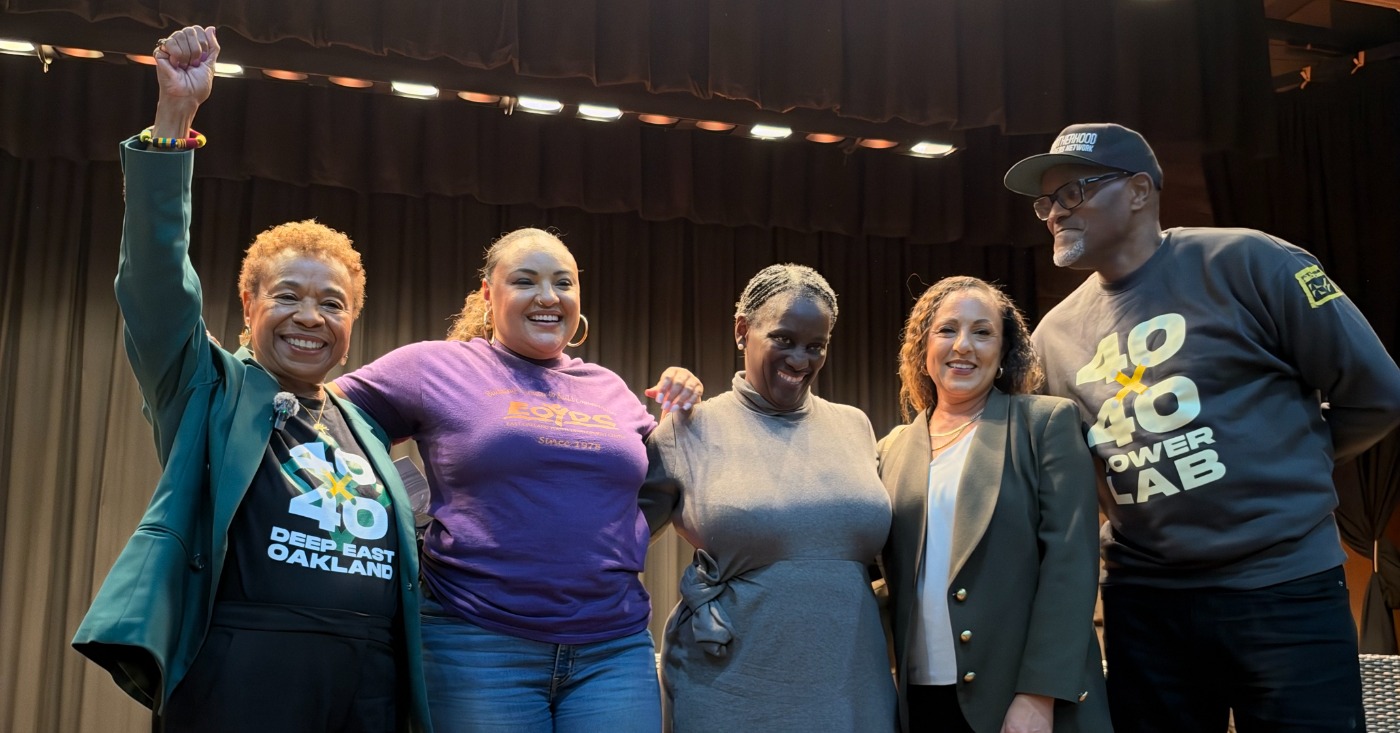
In partnership with Rise East and the 40×40 Council, Oakland Mayor Barbara Lee held a special 2026 State of the City East Oakland community conversation on Oct. 14.
The purpose of bringing a State of the City address directly to the community was to celebrate East Oakland, highlight the work underway, and look ahead to what neighbors, local businesses, youth, funders, community organizations, and partners can accomplish together.
Held at the Roots Community Health/Parker Elementary School Campus at 7929 Ney Ave., the event was emceed by special guest Mark Curry, Oakland native, comedian, and actor.
Lee shared how Rise East and the 40×40 Council have brought together the knowledge, relationships, and resources of people and organizations committed to East Oakland.
Residents bring lived experience, community organizations bring trusted relationships and philanthropy, and businesses bring resources and opportunity, she said, then turned to the government’s role: public investment, services and policy.
But, Lee intoned, City Hall has a responsibility to help connect those efforts.
“I am committed to listening to residents, working across departments and sectors, and helping open doors to opportunity. We must connect neighborhood priorities to the decisions we make about housing, economic development, safety, health and our young people.
City Hall “must be accountable for the results,” Lee said. “The measure of success is what families experience: greater stability, more opportunity and a stronger sense that they belong and have a future here.
“Tonight is an opportunity to listen to the leaders doing this work, learn what is making a difference and identify where we can do more together,” the mayor said.
Lee went on to moderate a ‘fireside chat’ on the theme: Building Oakland’s Future Together — From Neighborhood Investment to Community Empowerment with:
- Selena Wilson, CEO, East Oakland Youth Development Center
- Greg Hodge, CEO, Brotherhood of Elders
- Carolyn “CJ” Johnson, CEO, Black Cultural Zone
- Dr. Noha Aboelata, CEO, Roots Health Center
Mayor Barbara Lee’s media relations department provided this report.

Featured
Opponents Smear Effective African American Transit Director as Election Nears
Incumbent Joel Young is defending his seat on the AC Transit Board against allegations of harassment stemming from a public interaction in 2026. Supporters of the director cite his record of securing $600 million for bus services and leading civil rights initiatives as evidence of his effectiveness. They argue the accusations regarding a group photo interaction have been politically weaponized by opponents to influence the Ward 3 election.
I am an academic and a community activist. I take women’s issues, including workplace harassment and discrimination, seriously. I have been following the AC Transit Ward 3 election and have become concerned about what I believe is a serious injustice.
Joel Young is an effective AC Transit director. He has secured more than $600 million for local bus service and fare affordability. He led the Freedom Bus Project, integrating civil rights history, art and transit. He was presiding over the board of AC transit when it won the 2023 Outstanding Public System Award, and he raised $1 million for the hydrogen fuel cell bus program. These are just a few of his accomplishments.
I reviewed the allegations of unwanted physical contact and harassment made by AC Transit Director Sarah Syed against Director Joel Young, I believe the events of Sept. 24, 2025, have been characterized in a way that does not accurately reflect what occurred.
That interaction took place during a group photo after celebrating the life of a longtime Board member who passed away. From the video I reviewed, it appears that individuals were consoling one another and exchanging hugs in a public setting surrounded by numerous witnesses.
Young’s interaction with Syed appears consistent with those expressions of sympathy and it appears that Young was attempting to extend a gesture of goodwill toward Syed.
I am concerned by how this incident has been recently used as a political tool to influence the outcome of the AC Transit Ward 3 election and support Young’s opponent.
Syed and her supporters launched a targeted political campaign, first through the Alameda County Democratic Party and subsequently by organizing a letter from a group of majority-white elected officials who have endorsed Young’s opponent against Young, who is Africa American.
Furthermore, this manufactured controversy distracts voters from the critical issues facing AC Transit. The public deserves a substantive debate on service reliability, ridership recovery, passenger and operator safety, financial stability, regional equity, and future transportation infrastructure. The electorate should be evaluating which candidate possesses the judgment, experience, and vision to lead AC Transit forward – not reacting to a distorted personal interaction.
Regardless of one’s political views or preferred candidate, allegations of harassment should never be weaponized for electoral purposes. We all know that exaggerated or unsupported accusations can undermine public understanding of, and trust in, efforts to address genuine sexual harassment and violence.
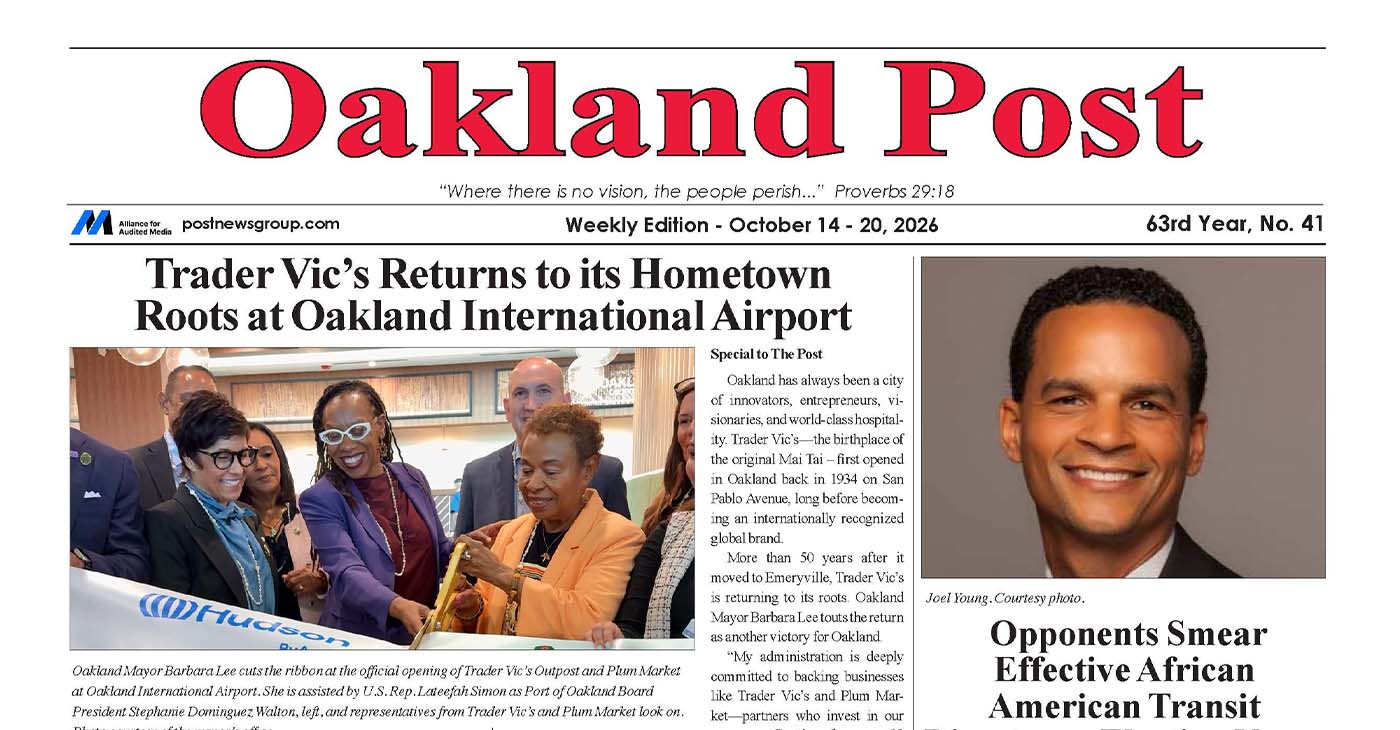
To enlarge your view of this issue, use the slider, magnifying glass icon or full page icon in the lower right corner of the browser window.

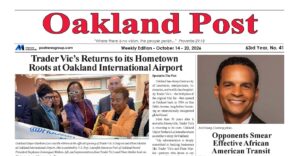


Mayor Barbara Lee Holds Special State of the City Address in Deep East Oakland

Practitioners of African Traditional Spirituality Offer Ancestral Reverence Ritual Oct. 31

It’s Time to Lose Weight Before the Holidays

Trader Vic’s Returns to Its Oakland Roots

Oakland Coal Terminal Backed by Trump Would Be Bigger, Dirtier Than Promised, Says Report

Opponents Smear Effective African American Transit Director as Election Nears

Oakland Post: Week of October 14 – 20, 2026

OP-ED: The Black Church Writes AI’s Next Chapter

OP-ED: The Black Church Writes AI’s Next Chapter

WCCUSD Joins Statewide Organic School Food Purchasing Cooperative

Democrats, Community Groups Back Measure EE to Change How Oakland Is Governed

Four Tips to Help You Plan a Holiday “Staycation”

Veterans Housing Project Proposed for South Richmond
PRESS ROOM: Transformative Justice Coalition 2026 Voting Rights Champion Awards Reception ‘Yesterday Is Today: The Battle For Voting Rights

Mayor Lee Delivers 2026 State of the City Address: ‘Oakland Continues to Be on the Move’

Misnamed ‘Parent’ PAC Seeks to Influence Oakland School Board Elections

Poll: Becerra Widens His Lead Over Hilton; Californians Split on Wealth Tax

Oakland Post: Week of September 9 – 15, 2026

County Office of Education Says OUSD Finances Are Getting Healthier, Materially Stronger

Listening as a Lifeline: A Doula’s Witness to Black Maternal Health

Richmond Tiny House Village Farm & Garden Set to Open Gates on Sept. 26

Mayor Lee Announces $1 Million Kaiser Permanente Grant for Pilot Program to Address Homelessness, Clean Up Public Spaces throughout Oakland

Latest Massacre in Haiti Reveals Cruelty U.S. Deportations

OPINION: Nolan Wells’ Death One of Several Signifying Racial Terror Lives on in U.S. South

Zakiya Jendayi Arrested, Locked Out of Home by Sheriff’s Deputies

BLACspace Cooperative Invites Bay Area to Experience Oakland’s Black Cultural Ecosystem Through a BLAC Map Tour + Party

Oakland Post: Week of September 16 – 22, 2026

Doulas Are Helping Black California Moms Navigate Pregnancy–Even as High Mortality Rates Persist

Oakland People’s Arms Embargo Coalition Demands End to Military Shipments Thru Oakland

Democratic Clubs Interview Candidates for Oakland School Board

The Conversation With Al McFarlane 6/23/26

Media Monday 6/22/26

LIVE! ASK ALMA! — TUES. 6.23.26 7PM EST

Car Buying Secrets: 4 Hidden Checks Before You Sign!

Is This 550 HP Charger Worth YOUR Money? AutoNetwork Review

Celebrating Juneteenth – Frederick Douglass on education and resistance

LIVE! — ASK ALMA! — TUES. 6.19.26 7PM EST

Hyundai Ioniq 5 Parking, Safety, and 360 View #shorts

2025 Ioniq 5 New Wiper & Powerful Performance! #shorts

Electric SUV Range: Is 259 Miles Enough? #shorts

EV Charging: How Fast Can You Charge an Electric Vehicle? #shorts

Biometric Cooling… Messaging Seats…Come on! 2025 Infiniti QX80 Autograph 4WD

Charged Up: Witness the Magic of a Fully Electric Car! #shorts

Range Rover Sport PHEV Included…: See What’s Inside This Luxury SUV! #shorts

Invisible Hood View: Perfect Parking with X-Ray Vision! #shorts
-
 Economy4 weeks ago
Poll: Becerra Widens His Lead Over Hilton; Californians Split on Wealth Tax
-
 Business4 weeks ago
County Office of Education Says OUSD Finances Are Getting Healthier, Materially Stronger
-
 Black History3 weeks ago
Listening as a Lifeline: A Doula’s Witness to Black Maternal Health
-
 Lead Story3 weeks ago
Zakiya Jendayi Arrested, Locked Out of Home by Sheriff’s Deputies
-
 Art4 weeks ago
BLACspace Cooperative Invites Bay Area to Experience Oakland’s Black Cultural Ecosystem Through a BLAC Map Tour + Party
-
 Black History4 weeks ago
Doulas Are Helping Black California Moms Navigate Pregnancy–Even as High Mortality Rates Persist
-
 Business4 weeks ago
From Historic Memories to New Possibilities: Oakland Celebrates Coliseum 60
-
 Community4 weeks ago
Asm. Corey Jackson Announces Launch of 24-Hour Childcare in His District
Politics
Ohio House OKs Bill Banning Abortions After 1st Heartbeat
Ohio State Rep. Christina Hagan (Courtesy of HaganForOhio.com)
JULIE CARR SMYTH, AP Statehouse Correspondent
COLUMBUS, Ohio (AP) — A bill that would ban most abortions after the first detectable fetal heartbeat again cleared the state House on Wednesday following a startlingly emotional floor debate in which a veteran female lawmaker revealed she’d been raped and had an abortion and a male legislator shed tears as he recounted praying his stillborn child would take a breath.
Advocates now have the rest of the two-year session to lobby the bill’s opponents in the Senate.
The Republican-controlled House approved the bill 55-40 in its third vote on it in as many sessions. The legislation met its demise in the Senate two sessions ago and last session made it as far as the House floor and was voted down.
Proponents on Wednesday defended the bill as life-protecting, while opponents called it unconstitutional and heavy-handed.
Sponsoring Rep. Christina Hagan, a Uniontown Republican, set the tone for the debate by revealing in her opening remarks that her heartbeat had stopped repeatedly while she was being delivered and her mother might have given up hope but didn’t.
“This bill is very much about loving women and loving children and providing that expansion of rights to the unborn,” she said.
Rep. Stephanie Howse, a Cleveland Democrat, also had to compose herself while speaking as she urged colleagues to “love thy neighbor,” including women she said make decisions to have abortions “in love.”
For Rep. Teresa Fedor, a Toledo Democrat, the debate was progressing with one important voice missing: that of the rape victim.
Fedor, a champion of legislation against human trafficking, jotted down words such as “judge,” ”God!” ”shame” and “political ambition” from Wednesday’s debate and, when enough of them filled her paper, stood to speak.
“I heard all these stories that just fit your scenario, and I respect that, but you don’t respect my reason — my rape, my abortion,” she said. “And I guarantee you there are other women who should stand up with me and be courageous enough to speak that voice.”
She called the bill “fundamentally inhuman.”
After the vote, Fedor told several reporters she was “very young” when she was raped and had told “probably two people.”
“I’m in this political arena, you know, and you have to make a decision: How far are you willing to go to really represent?” she said. “And then, with something like this (bill), it just was time.”
The Associated Press generally doesn’t identify people who say they’re victims of sexual assaults unless they come forward publicly, as Fedor has done.
Several major anti-abortion groups, including Ohio Right to Life, have failed to support passage of the heartbeat bill, fearing it would prompt a losing challenge to the U.S. Supreme Court’s Roe v. Wade decision that would serve only to expand abortion rights.
Senate President Keith Faber, a Celina Republican, said he shared those concerns but intends to review the latest version of the bill and hold hearings.
“I’m still waiting for that legal scholar to come forward and say, ‘The heartbeat bill is constitutional,'” he said.
___
Associated Press reporter Ann Sanner contributed to this report.
Copyright 2015 The Associated Press. All rights reserved. This material may not be published, broadcast, rewritten or redistributed.
Community
Mayor Barbara Lee Holds Special State of the City Address in Deep East Oakland
In partnership with Rise East and the 40×40 Council, Oakland Mayor Barbara Lee held a special 2026 State of the City East Oakland community conversation on Oct. 14. The purpose of bringing a State of the City address directly to the community was to celebrate East Oakland, highli
In partnership with Rise East and the 40×40 Council, Oakland Mayor Barbara Lee held a special 2026 State of the City East Oakland community conversation on Oct. 14.
The purpose of bringing a State of the City address directly to the community was to celebrate East Oakland, highlight the work underway, and look ahead to what neighbors, local businesses, youth, funders, community organizations, and partners can accomplish together.
Held at the Roots Community Health/Parker Elementary School Campus at 7929 Ney Ave., the event was emceed by special guest Mark Curry, Oakland native, comedian, and actor.
Lee shared how Rise East and the 40×40 Council have brought together the knowledge, relationships, and resources of people and organizations committed to East Oakland.
Residents bring lived experience, community organizations bring trusted relationships and philanthropy, and businesses bring resources and opportunity, she said, then turned to the government’s role: public investment, services and policy.
But, Lee intoned, City Hall has a responsibility to help connect those efforts.
“I am committed to listening to residents, working across departments and sectors, and helping open doors to opportunity. We must connect neighborhood priorities to the decisions we make about housing, economic development, safety, health and our young people.
City Hall “must be accountable for the results,” Lee said. “The measure of success is what families experience: greater stability, more opportunity and a stronger sense that they belong and have a future here.
“Tonight is an opportunity to listen to the leaders doing this work, learn what is making a difference and identify where we can do more together,” the mayor said.
Lee went on to moderate a ‘fireside chat’ on the theme: Building Oakland’s Future Together — From Neighborhood Investment to Community Empowerment with:
- Selena Wilson, CEO, East Oakland Youth Development Center
- Greg Hodge, CEO, Brotherhood of Elders
- Carolyn “CJ” Johnson, CEO, Black Cultural Zone
- Dr. Noha Aboelata, CEO, Roots Health Center
Mayor Barbara Lee’s media relations department provided this report.
Featured
Opponents Smear Effective African American Transit Director as Election Nears
Incumbent Joel Young is defending his seat on the AC Transit Board against allegations of harassment stemming from a public interaction in 2026. Supporters of the director cite his record of securing $600 million for bus services and leading civil rights initiatives as evidence of his effectiveness. They argue the accusations regarding a group photo interaction have been politically weaponized by opponents to influence the Ward 3 election.
I am an academic and a community activist. I take women’s issues, including workplace harassment and discrimination, seriously. I have been following the AC Transit Ward 3 election and have become concerned about what I believe is a serious injustice.
Joel Young is an effective AC Transit director. He has secured more than $600 million for local bus service and fare affordability. He led the Freedom Bus Project, integrating civil rights history, art and transit. He was presiding over the board of AC transit when it won the 2023 Outstanding Public System Award, and he raised $1 million for the hydrogen fuel cell bus program. These are just a few of his accomplishments.
I reviewed the allegations of unwanted physical contact and harassment made by AC Transit Director Sarah Syed against Director Joel Young, I believe the events of Sept. 24, 2025, have been characterized in a way that does not accurately reflect what occurred.
That interaction took place during a group photo after celebrating the life of a longtime Board member who passed away. From the video I reviewed, it appears that individuals were consoling one another and exchanging hugs in a public setting surrounded by numerous witnesses.
Young’s interaction with Syed appears consistent with those expressions of sympathy and it appears that Young was attempting to extend a gesture of goodwill toward Syed.
I am concerned by how this incident has been recently used as a political tool to influence the outcome of the AC Transit Ward 3 election and support Young’s opponent.
Syed and her supporters launched a targeted political campaign, first through the Alameda County Democratic Party and subsequently by organizing a letter from a group of majority-white elected officials who have endorsed Young’s opponent against Young, who is Africa American.
Furthermore, this manufactured controversy distracts voters from the critical issues facing AC Transit. The public deserves a substantive debate on service reliability, ridership recovery, passenger and operator safety, financial stability, regional equity, and future transportation infrastructure. The electorate should be evaluating which candidate possesses the judgment, experience, and vision to lead AC Transit forward – not reacting to a distorted personal interaction.
Regardless of one’s political views or preferred candidate, allegations of harassment should never be weaponized for electoral purposes. We all know that exaggerated or unsupported accusations can undermine public understanding of, and trust in, efforts to address genuine sexual harassment and violence.
To enlarge your view of this issue, use the slider, magnifying glass icon or full page icon in the lower right corner of the browser window.
-
Economy4 weeks ago
Poll: Becerra Widens His Lead Over Hilton; Californians Split on Wealth Tax
-
Business4 weeks ago
County Office of Education Says OUSD Finances Are Getting Healthier, Materially Stronger
-
Black History3 weeks ago
Listening as a Lifeline: A Doula’s Witness to Black Maternal Health
-
Lead Story3 weeks ago
Zakiya Jendayi Arrested, Locked Out of Home by Sheriff’s Deputies
-
Art4 weeks ago
BLACspace Cooperative Invites Bay Area to Experience Oakland’s Black Cultural Ecosystem Through a BLAC Map Tour + Party
-
Black History4 weeks ago
Doulas Are Helping Black California Moms Navigate Pregnancy–Even as High Mortality Rates Persist
-
Business4 weeks ago
From Historic Memories to New Possibilities: Oakland Celebrates Coliseum 60
-
Community4 weeks ago
Asm. Corey Jackson Announces Launch of 24-Hour Childcare in His District

Leave a Reply