
Crime
Skinner’s Bill Would Raise the Age to be Tried as an Adult

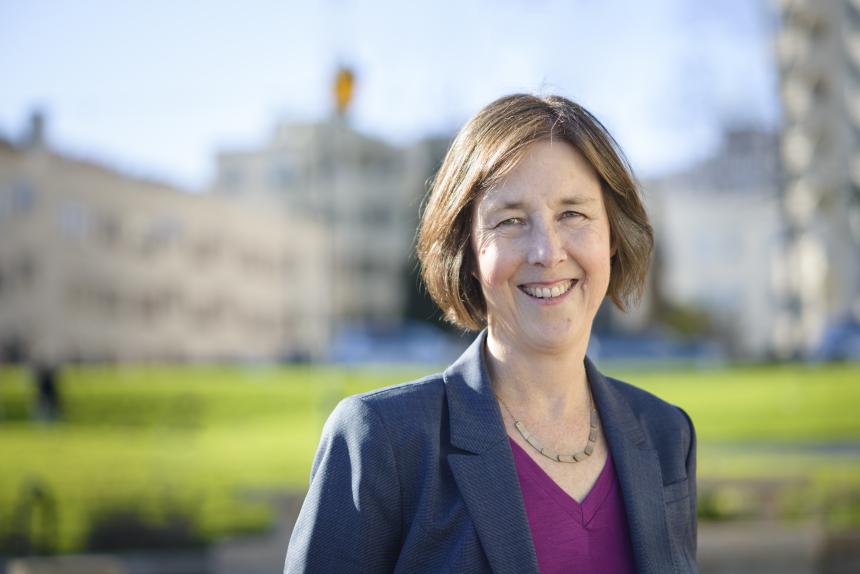
Sen. Nancy Skinner, D-Berkeley this week introduced Senate Bill 889, which would raise the age at which young people in California are automatically tried as adults to 20 years old. Under the bill, 18- and 19-year-olds would be treated as juveniles in criminal proceedings.
“When teenagers make serious mistakes and commit crimes, state prison is not the answer. Processing teenagers through the juvenile justice system will help ensure they receive the appropriate education, counseling, treatment, and rehabilitation services necessary to achieve real public safety outcomes,” Sen. Skinner said.
Sen. Skinner and her staff are working closely with numerous stakeholders, including the Chief Probation Officers of California (CPOC), National Center for Youth Law, and other juvenile justice advocates to craft the legislation.
Brain science research has shown that the prefrontal cortex, the part of the brain that helps inhibit impulses and enables organized and planned behavior, is not yet fully developed in 18- and 19-year-olds. This research, as well as the documented higher incidents of car accidents among 18- and 19-year-olds, is what led most states to raise the legal drinking age to 21 and car rental companies to restrict their services to those 21 and older. The intent of SB 889 is to align the treatment of 18- and 19-year-olds with California’s current law that specifies that 16- and 17-year-olds can only be tried as adults in specified circumstances.

“This is a reform whose time has come,” said David Steinhart, a state and national juvenile justice expert who is also director of the Commonweal Juvenile Justice Program. “The law is changing —nationally and in the states—to incorporate adolescent development and brain science into the juvenile and criminal codes. This bill will make youth services, programs, and enhanced supervision available to 18- and 19-year-olds, who when processed in the adult system, get little or nothing in the way of support or rehabilitation. It will improve public safety by putting thousands of California’s youth back into education and on job tracks that are blocked when they are processed as adults. There are implementation issues that need to be worked out, but the concept is sound, grounded in science, with potentially strong benefits for youth and for community safety.”
“CPOC wants to thank Sen. Skinner for further demonstrating her commitment to the evolution of juvenile justice in California by partnering with CPOC to expand the positive impacts of the last decade, which have vastly improved the outcomes for youth in California,” said Chief Brian Richart, president of CPOC. “Probation has proven that an evidence-based approach focused on a balance of rehabilitation and accountability is what works to protect public safety, restore communities, and help rebuild lives. This legislation is the natural and research-based evolution of our implemented reforms and will have an unprecedented impact on our youth. The brain science is clear and will help us holistically and individually focus on young people by incorporating proven rehabilitation and restorative justice practices, thereby improving our communities by supporting our youth.”
“Raising the age of juvenile court jurisdiction to include 18- and 19-year-olds in conflict with the law makes sense on so many levels,” said Frankie Guzman, director of the Youth Justice Initiative at the National Center for Youth Law. “Science and common experience have shown us that, although legally considered adults, older adolescents are immature and still developing mentally and emotionally. Decades of research have proven that the most effective way to reduce crime is by providing education and treatment services— services that do not exist in the adult system. Developing a bill to treat 18- and 19-year-olds as youth and emphasize rehabilitation, rather than punishment, would create tremendous opportunity to promote healthy adolescent development and reduce crime, and more effectively promote public health and safety in California.”
“Under California law, teenagers can’t buy cigarettes, beer, or even rent a car, yet they can be sent to prison for the rest of their lives. Kids should be treated like kids,” said Alameda County Public Defender Brendon Woods. “When a young person gets in trouble, they need our help. They don’t need to be locked in a cage. School, employment, counseling, mentoring, and services provided by community-based organizations—these prevent recidivism. It’s time for California to start giving kids what they need to be their best, and raising the age is a concrete step in the right direction.”








To enlarge your view of this issue, use the slider, magnifying glass icon or full page icon in the lower right corner of the browser window.


To enlarge your view of this issue, use the slider, magnifying glass icon or full page icon in the lower right corner of the browser window.
Activism
Oakland Post: Week of September 30 – October 6, 2026
The printed Weekly Edition of the Oakland Post: Week of September 30 – October 6, 2026


To enlarge your view of this issue, use the slider, magnifying glass icon or full page icon in the lower right corner of the browser window.



Mayor Barbara Lee Holds Special State of the City Address in Deep East Oakland

Practitioners of African Traditional Spirituality Offer Ancestral Reverence Ritual Oct. 31

It’s Time to Lose Weight Before the Holidays

Trader Vic’s Returns to Its Oakland Roots

Oakland Coal Terminal Backed by Trump Would Be Bigger, Dirtier Than Promised, Says Report

Opponents Smear Effective African American Transit Director as Election Nears

Oakland Post: Week of October 14 – 20, 2026

OP-ED: The Black Church Writes AI’s Next Chapter

OP-ED: The Black Church Writes AI’s Next Chapter

WCCUSD Joins Statewide Organic School Food Purchasing Cooperative

Democrats, Community Groups Back Measure EE to Change How Oakland Is Governed

Four Tips to Help You Plan a Holiday “Staycation”

Veterans Housing Project Proposed for South Richmond
PRESS ROOM: Transformative Justice Coalition 2026 Voting Rights Champion Awards Reception ‘Yesterday Is Today: The Battle For Voting Rights

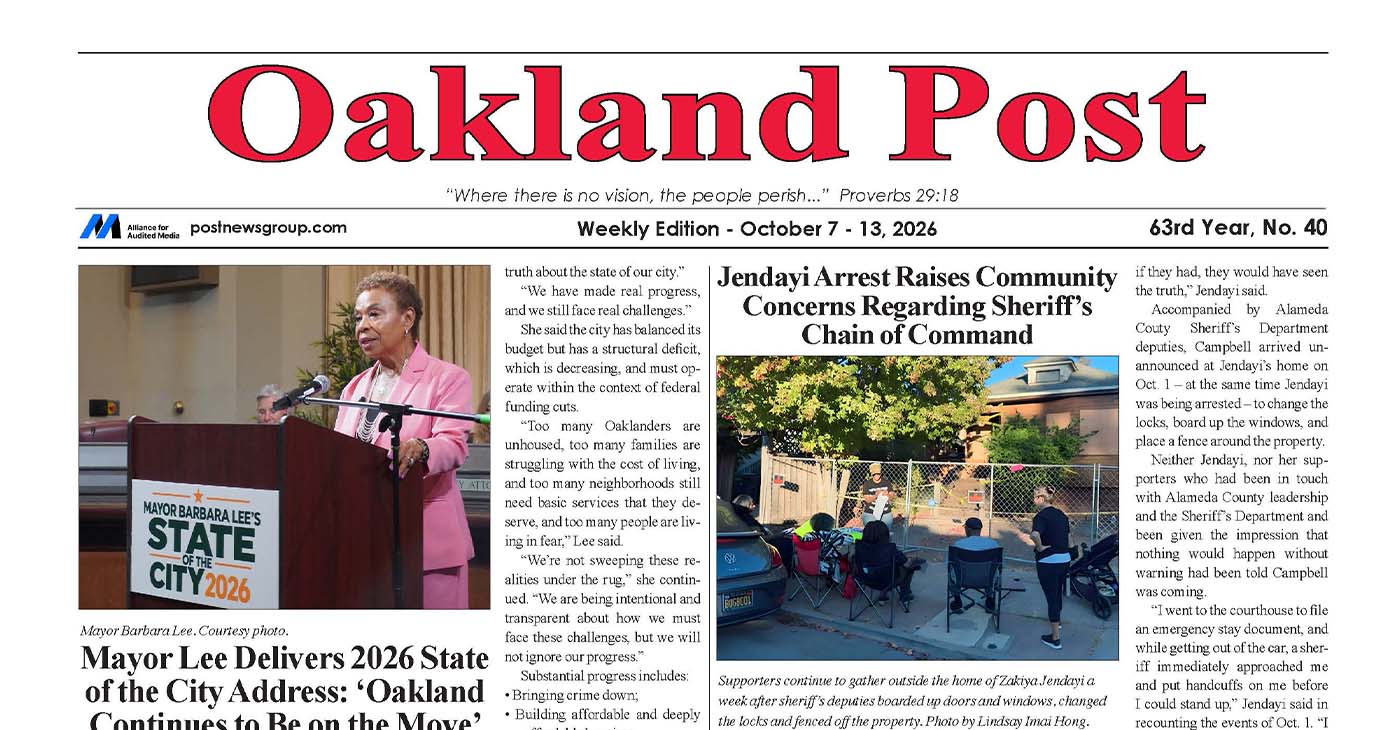
Mayor Lee Delivers 2026 State of the City Address: ‘Oakland Continues to Be on the Move’

Misnamed ‘Parent’ PAC Seeks to Influence Oakland School Board Elections

Listening as a Lifeline: A Doula’s Witness to Black Maternal Health

Poll: Becerra Widens His Lead Over Hilton; Californians Split on Wealth Tax

Oakland Post: Week of September 9 – 15, 2026

County Office of Education Says OUSD Finances Are Getting Healthier, Materially Stronger

Richmond Tiny House Village Farm & Garden Set to Open Gates on Sept. 26

Mayor Lee Announces $1 Million Kaiser Permanente Grant for Pilot Program to Address Homelessness, Clean Up Public Spaces throughout Oakland

Doulas Are Helping Black California Moms Navigate Pregnancy–Even as High Mortality Rates Persist

Latest Massacre in Haiti Reveals Cruelty U.S. Deportations

OPINION: Nolan Wells’ Death One of Several Signifying Racial Terror Lives on in U.S. South

Zakiya Jendayi Arrested, Locked Out of Home by Sheriff’s Deputies

BLACspace Cooperative Invites Bay Area to Experience Oakland’s Black Cultural Ecosystem Through a BLAC Map Tour + Party

Oakland Post: Week of September 16 – 22, 2026

Democratic Clubs Interview Candidates for Oakland School Board

Oakland People’s Arms Embargo Coalition Demands End to Military Shipments Thru Oakland

The Conversation With Al McFarlane 6/23/26

Media Monday 6/22/26

LIVE! ASK ALMA! — TUES. 6.23.26 7PM EST

Car Buying Secrets: 4 Hidden Checks Before You Sign!

Is This 550 HP Charger Worth YOUR Money? AutoNetwork Review

Celebrating Juneteenth – Frederick Douglass on education and resistance

LIVE! — ASK ALMA! — TUES. 6.19.26 7PM EST

Hyundai Ioniq 5 Parking, Safety, and 360 View #shorts

2025 Ioniq 5 New Wiper & Powerful Performance! #shorts

Electric SUV Range: Is 259 Miles Enough? #shorts

EV Charging: How Fast Can You Charge an Electric Vehicle? #shorts

Biometric Cooling… Messaging Seats…Come on! 2025 Infiniti QX80 Autograph 4WD

Charged Up: Witness the Magic of a Fully Electric Car! #shorts

Range Rover Sport PHEV Included…: See What’s Inside This Luxury SUV! #shorts

Invisible Hood View: Perfect Parking with X-Ray Vision! #shorts
-
 Black History3 weeks ago
Listening as a Lifeline: A Doula’s Witness to Black Maternal Health
-
 Economy4 weeks ago
Poll: Becerra Widens His Lead Over Hilton; Californians Split on Wealth Tax
-
 Business4 weeks ago
County Office of Education Says OUSD Finances Are Getting Healthier, Materially Stronger
-
 Lead Story3 weeks ago
Zakiya Jendayi Arrested, Locked Out of Home by Sheriff’s Deputies
-
 Art4 weeks ago
BLACspace Cooperative Invites Bay Area to Experience Oakland’s Black Cultural Ecosystem Through a BLAC Map Tour + Party
-

 Business4 weeks ago
From Historic Memories to New Possibilities: Oakland Celebrates Coliseum 60
-
 Community4 weeks ago
Asm. Corey Jackson Announces Launch of 24-Hour Childcare in His District
-

 Black History4 weeks ago
IN MEMORIAM: The Rev. Leon “Sonny” Clark, Longtime Orange County Pastor and Community Leader, Dies at 72
