
City Government
Opinion: City Must Mitigate Bus Rapid Transit impacts


 AC Transit’s East Bay Bus Rapid Transit (BRT) is going to permanently and drastically change International Boulevard from a four-lane boulevard with ample parking to a two-lane street with 300 fewer parking spaces
As these plans became clear, businesses along its 9.5-mile route organized in 2016 to pressure the City of Oakland to establish the Business Assistance Sustainability Fund (BASF) to mitigate permanent BRT impacts.
While this is an important and necessary program, it is far from sufficient to protect this Black, Brown and Asian businesses from displacement. We must do better.
The BRT Mitigation Fund provides $2,165,000 within the City of Oakland ($255K for San Leandro) to “address direct temporary construction impacts to businesses and make referrals and provide technical support as needed for technical mitigation during construction.”
This fund was capped at a maximum of $100K for each applicant.
The funding for the BRT Technical Assistance and Business Assistance Fund programs was set up to assist merchants in a technical capacity that includes assistance with marketing and addressing changes as a result of the reconfiguration along the International corridor.
Numerous businesses began to exhibit “going out of business” signs, including the Perry Furniture store that has been located on 72nd Avenue for decades.

After canvassing the area on different dates and times to factor in various shifts, it was discovered that not only were the merchants unaware – many were losing customers, and their businesses were being adversely impacted by the delayed construction, even during times where not a single construction worker was visible.
But parking spaces were blocked off, including even access to the entrance of some of these businesses.
After listening to a number of merchants, and the consequent BRT Informational update that was provided during the Council’s Public Works Committee meeting on April 9, it became abundantly clear that changes are needed to the program to ensure assistance, including:
• Provide an additional $5 million;
• Allow funds to address permanent impacts or temporary construction impacts;
• Streamline the permanent impacts application;
• Create separate eligibility criteria and disbursement guidelines for staff and consultants for temporary construction impacts’ funding;
• When construction continues, either consecutively of concurrently, for more than 30 calendar days, businesses will be paid their mortgage and utilities bills on a pro rata basis for every day beyond 30 days upon presentation of their most recent mortgage statement and past 3 months of utility bills.
There will be a Merchant Town Hall taking place Friday May 3, 2:30 p.m., at East Bay Asian Youth Center (EBAYC) at 2025 East 12th St. It is important to understand why few businesses have received funding and to center the voices of those directly impacted.
A majority of Oakland businesses of businesses are d “Mom and Pop” stores. Opposing displacement includes fighting for East Oakland residents and preserving small businesses as well.
During the height of the crack cocaine epidemic in the 1980s, storefronts in my neighborhood were not only open but thriving. At a time when prosperity and development is being proclaimed from City Hall, the benefits are clearly not getting extended to East Oakland.
The city needs to prioritize the health and well-being of these merchants who, like East Oakland residents, are impacted by decisions that not only were they not present to provide input on but required to suffer from what is proclaimed as the “good for the community,” which typically occurs at the expense of African Americans and other communities of color.
For more information, go to https://brt.actransit.org/construction/business-support-services/
John Jones III is an East Oakland resident.

Activism
Oakland Post: Week of September 9 – 15, 2026
The printed Weekly Edition of the Oakland Post: Week of September 9 – 15, 2026


To enlarge your view of this issue, use the slider, magnifying glass icon or full page icon in the lower right corner of the browser window.

Activism
Oakland Post: Week of September 2 – 8, 2026
The printed Weekly Edition of the Oakland Post: Week of September 2 – 8, 2026
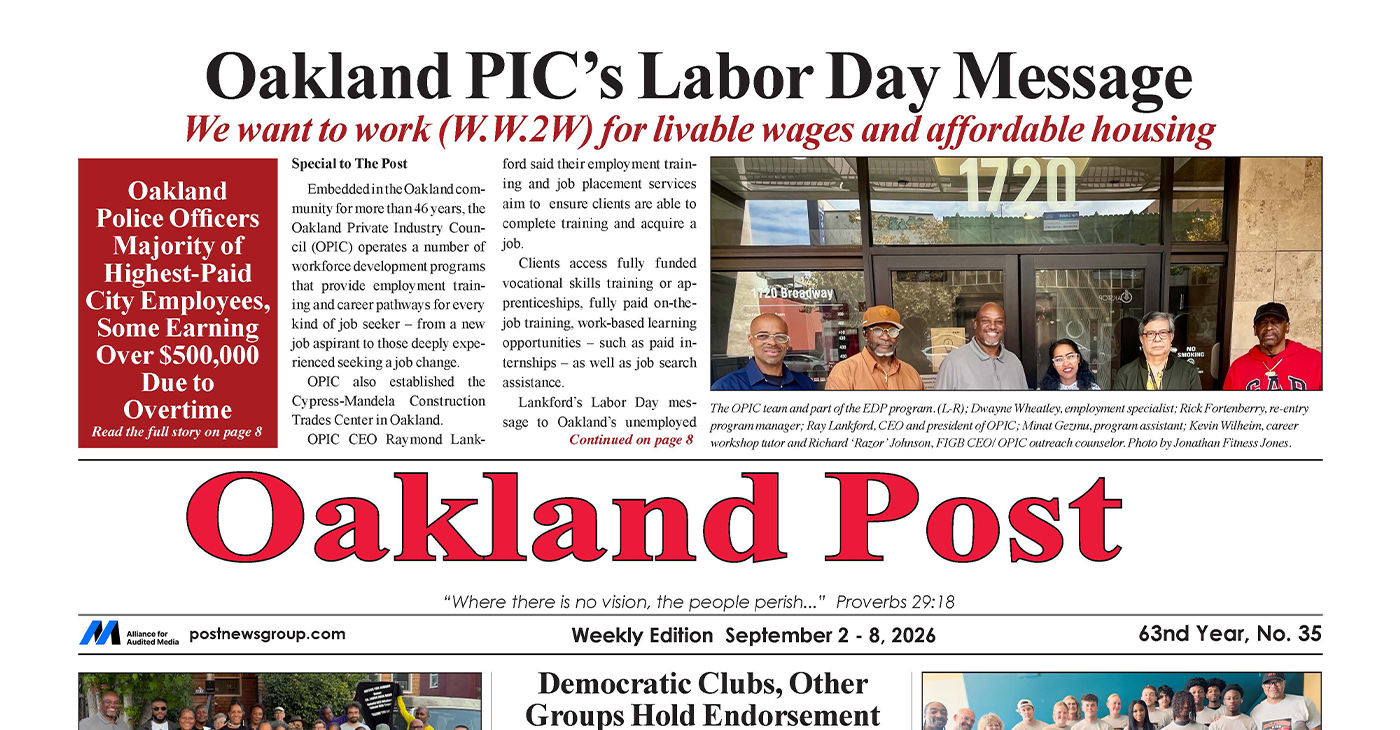
To enlarge your view of this issue, use the slider, magnifying glass icon or full page icon in the lower right corner of the browser window.
Activism
Oakland Post: Week of August 26 – September 1, 2026
The printed Weekly Edition of the Oakland Post: Week of August 26 – September 1, 2026

To enlarge your view of this issue, use the slider, magnifying glass icon or full page icon in the lower right corner of the browser window.



Port of Oakland, Army Corps Sign Historic Harbor Design Agreement

Democratic Clubs Interview Candidates for Oakland School Board

Nuna Phillips-McKee Celebrates 100 Years: ‘A Century of Faith, Family and God’s Amazing Grace!’

D.A. Ursula Jones Dickson: Terminix to Pay $3.15 Million Over Illegal Disposal of Pesticides, Customer Records

REPORT: Community Level Policy Is Impacting Homelessness and Drug Abuse in California
OPINION: AI Needs to Know Who Is the Boss
Goldi-Locs and Two (or Three) Bears in the Forest in California Hills

Election Watch 2026: 85% of Eligible Voters in California Are Registered

Don’t Let scammers Crash Your School Year

BOOK REVIEW — Curved Air: A Biography of Sickle Cell Anemia and the Quest to Cure the First Molecular Disease

California’s Legal Cannabis Market Hits $8 Billion as State Touts Progress on Fighting Drugs, Crime

Blacks and Latinos Clash Over LA’s Barrio Run; Mayor Karen Bass Calls for Dialogue Across Racial, Neighborhood Lines

Asm. Smallwood-Cuevas’s Bill Repealing ‘Racist’ CalWORKs ‘Man-in-the-House’ Rule Clears Legislature

Asm. Smallwood-Cuevas’s Bill Repealing ‘Racist’ CalWORKs ‘Man-in-the-House’ Rule Clears Legislature

‘Ready to See These Bills Become Law’: Sen. Weber’s Package of 15 Bills Advance to Gov. Newsom’s Desk

Department of Homeland Security Demands California Secretary of State Shirley N. Weber Scrub Voter Rolls

New Judge Could Decide if Karmelo Anthony Gets a New Trial

“The Power to See Threats Sooner”: Gov. Newsom, Safety Officials Showcase California’s Investments in Hi-Tech Wildfire Prevention

Alpha Kappa Alpha Sorority, Inc. Celebrates New North Atlantic Regional Director

California Sen. Padilla Joins Colleagues to Introduce Bill Imposing Term Limits on Supreme Court Justices

Less Affluent School Districts, Including Sacramento City, Face Threat of State Takeover

Car Wash Workers Cope with Lingering Impacts of ICE Raids

Oakland Post: Week of July 29 – August 4, 2026

How Oakland’s Courtsmith is Scaling its Business and Local Impact

ESSAY: California Can Close Its Colorectal Cancer Gap

Oakland Post: Week of August 5 – 11, 2026

As Part of Your Back-to- School Checklist, Vaccinate

Oakland ‘Port Serves as a Powerful Engine for Good Jobs and Economic Development

Gov. Newsom Signs New Affordable Housing Legislation

Gov. Newsom Announces $109.6 Million in Funding for 278 Supportive Homes in Bakersfield, Contra Costa, Sacramento and Fresno

The Conversation With Al McFarlane 6/23/26

Media Monday 6/22/26

LIVE! ASK ALMA! — TUES. 6.23.26 7PM EST

Car Buying Secrets: 4 Hidden Checks Before You Sign!

Is This 550 HP Charger Worth YOUR Money? AutoNetwork Review

Celebrating Juneteenth – Frederick Douglass on education and resistance

LIVE! — ASK ALMA! — TUES. 6.19.26 7PM EST

Hyundai Ioniq 5 Parking, Safety, and 360 View #shorts

2025 Ioniq 5 New Wiper & Powerful Performance! #shorts

Electric SUV Range: Is 259 Miles Enough? #shorts

EV Charging: How Fast Can You Charge an Electric Vehicle? #shorts

Biometric Cooling… Messaging Seats…Come on! 2025 Infiniti QX80 Autograph 4WD

Charged Up: Witness the Magic of a Fully Electric Car! #shorts

Range Rover Sport PHEV Included…: See What’s Inside This Luxury SUV! #shorts

Invisible Hood View: Perfect Parking with X-Ray Vision! #shorts
-

 Community4 weeks ago
Four Candidates, Including Incumbent Barbara Lee, Qualify for Oakland Mayor’s Race
-

 Commentary2 weeks ago
Standoff for Justice: Our Homes Are Worth Fighting For
-

 Business2 weeks ago
Gubernatorial Candidate Steve Hilton Blasts California New Tire Rules; Newsom Hits Back
-

 Activism2 weeks ago
Oakland Post: Week of August 26 – September 1, 2026
-

 Education2 weeks ago
Gov. Newsom’s Latest Appointees Include Sacramento Advocate for Formerly Incarcerated Students; State’s New Tech Chief
-

 Business2 weeks ago
Frontier Airlines’ Return to Oakland Airport Brings Flights, Jobs and Opportunity
-

 Community2 weeks ago
Big City Mayors Ask for “Yes” Vote on Housing Bond Measure; Conservatives Say “No”
-

 Business2 weeks ago
Oakland Coliseum Project Opens Door for Small Businesses to Build Bigger
