
City Government
Leaders Respond to Building Trades Threats to Fund Desley Brooks’ Opposition PAC


Councilwoman Desley Brooks has refused to take a position on whether or not the city should adopt a policy which is called a “Project Labor Agreement” until she is given assurances that the PLA will benefit Oakland’s Black community.
In response, the construction unions have threatened to create an Independent Expenditure Committee to fund a negative campaign to help candidates running against her, unless Brooks will agree to vote for this policy.
Why is this a problem? First, coercing the vote of an elected official with threats of money to an unnamed, unaccountable Independent Expenditure Committee feels shady.
And second, we, the authors, are convinced that this city-wide Project Labor Agreement is a bad idea.
We are progressive in Oakland and we tend to support union actions automatically. This is often a good instinct. The Longshore Workers union, teachers’ union, nurses’ union, city worker unions, auto union and many others have created both economic and racial progress with their struggles.
But nobody should get a pass on racial justice.
And many of the construction unions have never gotten over their racial history. African-Americans get only 9 percent of the work on city-funded construction projects, although Black people make up a quarter of Oakland’s population.

The trades are asking for a “Project Labor Agreement,” which means their members will get almost all the work on these city-funded projects, and few of their members are Black.
The trades have consistently refused to release the numbers of people in their unions by ethnicity. So, they are asking the public to turn over our tax dollars to a select set of employees without regard for whether Black people make up a fair share of those employees.
And a walk around Oakland to look at most construction sites makes it clear that they do not. By all the information we can gather, most of the construction unions, especially those with better pay, have few Black members, because of a set of barriers which include various tests, the location of required apprentice training programs far away from Oakland, and others.
A major problem is that African-Americans in Oakland do not currently have the political power to create solutions for their communities. But the issue is much bigger than Black people.
It’s about equity and the moral compass of our city and society as a whole. The City of Oakland’s Equity indicators report confirms that bias and privilege have tangible outcomes build on a history of racism.
Councilmember Desley Brooks is the lone voice that is demanding more, and she is being persecuted for it – a scenario that also has familiar and historic roots.
With the dwindling Black population, the rising cost of living and the widening wealth gap, it is critical that African-Americans have good living wage jobs. We need many champions pushing to make that a reality NOW, not a distant hope or promise for a future that may never come.
We encourage the construction unions to desist from coercing an elected official to do something do something she may have concluded is morally wrong – voting against the employment needs of the African-American community
And we encourage those unions to break down the barriers to Black participation in their unions, so that eventually they will be willing to report openly on the ethnic composition of their membership, and the taxes of Black families will pay for projects on which they are also allowed to work.
Signed (organizations for identification only),
Carroll Fife, Executive Committee, Oakland Branch NAACP;
Kitty Kelly Epstein, PhD, professor of education and urban studies;
Darleen Brooks;
Henry Hitz; executive director emeritus, Oakland Parents Together:
Robyn Hodges









Activism
Oakland Post: Week of September 23 – 29, 2026
The printed Weekly Edition of the Oakland Post: Week of September 23 – 29, 2026

To enlarge your view of this issue, use the slider, magnifying glass icon or full page icon in the lower right corner of the browser window.
Activism
Oakland Post: Week of September 16 – 22, 2026
The printed Weekly Edition of the Oakland Post: Week of September 16 – 22, 2026
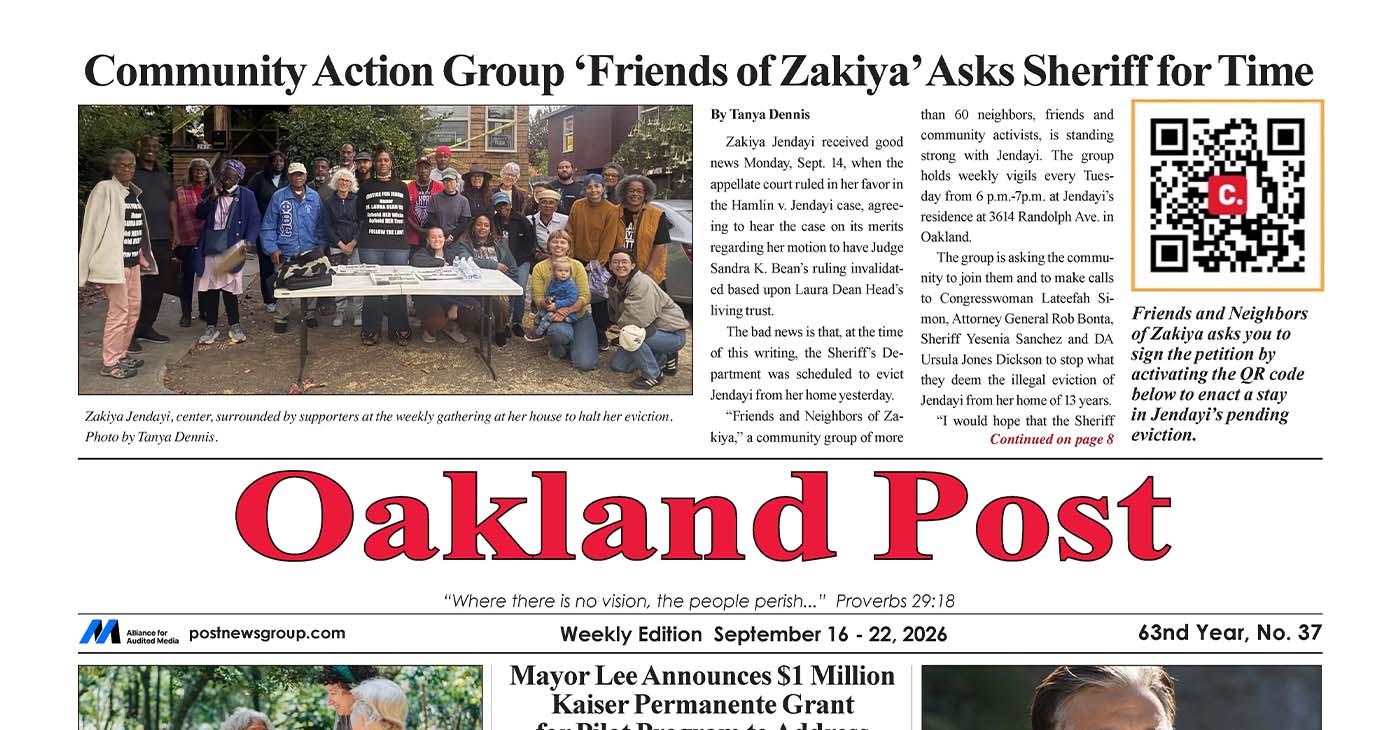
To enlarge your view of this issue, use the slider, magnifying glass icon or full page icon in the lower right corner of the browser window.
Activism
Oakland Post: Week of September 9 – 15, 2026
The printed Weekly Edition of the Oakland Post: Week of September 9 – 15, 2026

To enlarge your view of this issue, use the slider, magnifying glass icon or full page icon in the lower right corner of the browser window.


Asm. Corey Jackson Announces Launch of 24-Hour Childcare in His District

IN MEMORIAM: The Rev. Leon “Sonny” Clark, Longtime Orange County Pastor and Community Leader, Dies at 72

Poll: Becerra Widens His Lead Over Hilton; Californians Split on Wealth Tax

From Historic Memories to New Possibilities: Oakland Celebrates Coliseum 60

County Office of Education Says OUSD Finances Are Getting Healthier, Materially Stronger

LIVE FREE Sunday Dinner Brings Faith, Fellowship and Civic Conversation to Oakland

Remembering Chauncey Bailey as Student Journalists Face Threats to Truth-Telling

BLACspace Cooperative Invites Bay Area to Experience Oakland’s Black Cultural Ecosystem Through a BLAC Map Tour + Party

In Wake of Death on Doorstep, Williams Chapel Baptist Church Calls for Better Care, Funding for Unhoused

Oakland Centenarian Nuna McKee Honored!

Caribbean Nations Produce Action Plan Calling for UK Reparations Over Slavery

Oakland Post: Week of September 23 – 29, 2026

Doulas Are Helping Black California Moms Navigate Pregnancy–Even as High Mortality Rates Persist

Newsom Signs Addictive Social Media Law to Protect Kids

On Your November Ballot: Prop 38 Would Allocate $8.4 Billion to Immunology and Immunotherapy Funding

Less Affluent School Districts, Including Sacramento City, Face Threat of State Takeover

ESSAY: California Can Close Its Colorectal Cancer Gap

California Hispanic Chambers of Commerce Unveils: ‘Powering the Future’ Theme for 47th Annual Statewide Convention

Four Candidates, Including Incumbent Barbara Lee, Qualify for Oakland Mayor’s Race

Oakland Post: Week of August 12 – 18, 2026

From Blueprint to Breakthrough: Tackling Affordable Housing in Oakland

Oakland Observes Black August with Block Parties, Film Showings, Workshops

COMMENTARY: Why Local School Tax Measure G1 Will Not Be on the November Ballot

Standoff for Justice: Our Homes Are Worth Fighting For

Returning to Its Roots, the Oakland Black-Eyed Pea Festival Partners with the Freedom Farmers Market Sept. 12

Oakland Post: Week of August 26 – September 1, 2026

NPRC Scores First Advocacy Victory: David Shaw Finally Gets His Wish to ‘Go Home’

Frontier Airlines’ Return to Oakland Airport Brings Flights, Jobs and Opportunity

Gubernatorial Candidate Steve Hilton Blasts California New Tire Rules; Newsom Hits Back

Chef Sharon Lee Blends Culinary Excellence, Education and Empowerment

The Conversation With Al McFarlane 6/23/26

Media Monday 6/22/26

LIVE! ASK ALMA! — TUES. 6.23.26 7PM EST

Car Buying Secrets: 4 Hidden Checks Before You Sign!

Is This 550 HP Charger Worth YOUR Money? AutoNetwork Review

Celebrating Juneteenth – Frederick Douglass on education and resistance

LIVE! — ASK ALMA! — TUES. 6.19.26 7PM EST

Hyundai Ioniq 5 Parking, Safety, and 360 View #shorts

2025 Ioniq 5 New Wiper & Powerful Performance! #shorts

Electric SUV Range: Is 259 Miles Enough? #shorts

EV Charging: How Fast Can You Charge an Electric Vehicle? #shorts

Biometric Cooling… Messaging Seats…Come on! 2025 Infiniti QX80 Autograph 4WD

Charged Up: Witness the Magic of a Fully Electric Car! #shorts

Range Rover Sport PHEV Included…: See What’s Inside This Luxury SUV! #shorts

Invisible Hood View: Perfect Parking with X-Ray Vision! #shorts
-
 Commentary4 weeks ago
Standoff for Justice: Our Homes Are Worth Fighting For
-
 Activism4 weeks ago
Oakland Post: Week of August 26 – September 1, 2026
-
 Business4 weeks ago
Frontier Airlines’ Return to Oakland Airport Brings Flights, Jobs and Opportunity
-
 Business4 weeks ago
Gubernatorial Candidate Steve Hilton Blasts California New Tire Rules; Newsom Hits Back
-
 Business4 weeks ago
Chef Sharon Lee Blends Culinary Excellence, Education and Empowerment
-

 Community4 weeks ago
Big City Mayors Ask for “Yes” Vote on Housing Bond Measure; Conservatives Say “No”
-

 Black History4 weeks ago
Jackie Wright Champions Bay Area Stories, Filmmakers and Cultural Institutions
-

 Education4 weeks ago
Gov. Newsom’s Latest Appointees Include Sacramento Advocate for Formerly Incarcerated Students; State’s New Tech Chief
