
City Government
Donna Powers – She’s Back and She Wants to Help Fix Richmond’s City Council

Former City Councilmember Donna Powers is considering a return to Richmond’s City Council. Powers first joined the local political fray in 1991 with a run for city council.
Community members remember Powers as someone who shook things up on the Richmond City Council in the 1990s. She developed a reputation as a councilmember who got things done when other council members and administration seemed mired in bureaucratic complications and political stalemate.
Now she is back and gearing up to take on the tumultuous problems that have taken over city hall.
Donna is a street-smart woman and one heck of a hard worker,” says retired Berkeley professor and businessman Bob Goshay, who has lived in Richmond since 1977 and has known Powers for more than 20 years.
Powers was born in Tulsa, Oklahoma. Shortly after her father left for the war, Powers’ mother moved the family to Oakland, CA. Powers recalls that those were tough times; her parents got divorced and her mother changed jobs often to try her best to provide for everyone.
After graduating from high school, Powers found work at a bank in San Francisco and moved to Point Richmond where she met and married her husband. They raised a daughter here.

In the early 1990s, Powers became deeply involved in local politics when she found some shocking evidence of financial mismanagement and malfeasance in the budget.
She sued the Richmond City Council and took the case all the way to the Supreme Court of California (Powers v. City of Richmond), where she won.
She was then elected to office in 1991 and used the Powers decision to help put into place Richmond’s “sunshine” ordinance, which governs the city’s disclosure of its financial records to the public.
In 1993, Richmond suffered the fallout from a chemical spill emanating from the General Chemical plant in town. Powers saw an opportunity to take the reins and help Richmond recover to bring some good from a tragic occurrence.
She immediately organized an effort on the part of the city, Contra Costa County, and industry experts to put into place a first-of-its-kind chemical and disaster warning system. The system was considered so revolutionary at the time that Powers and her colleagues on the project received an award from the federal government for their work.
Another significant contribution Powers made was the creation of the Rosie the Riveter memorial site and the movement to get the City to fund the honoring of the women of Richmond that had worked in the Kaiser shipyards.
Powers convinced the National Park Service of the site’s historical merit and President Bill Clinton signed the certification for the Rosie the Riveter National Memorial and for other sites throughout Richmond just before he left office.
“She went from having nothing to work with, to having a full-fledged national park in place within five years,” recalls Phyllis Gould, a 92-year-old Richmond resident whom Powers involved in the project. “It was simply amazing.”
Shortly after, Powers was forced to leave her council position to care for older family members. She left behind her a city with a new iconic mascot, a hugely improved system for financial disclosures for its officials, and a warning system that remains to this day one of the most important safety measures ever implemented in an industrial area in the nation.
“I am like water,” Powers says. “I will find a way around any obstacle standing in the way of efforts for this city; I will go up and over, around, or under anything to get things done.”












Activism
Oakland Post: Week of August 12 – 18, 2026
The printed Weekly Edition of the Oakland Post: Week of August 12 – 18, 2026
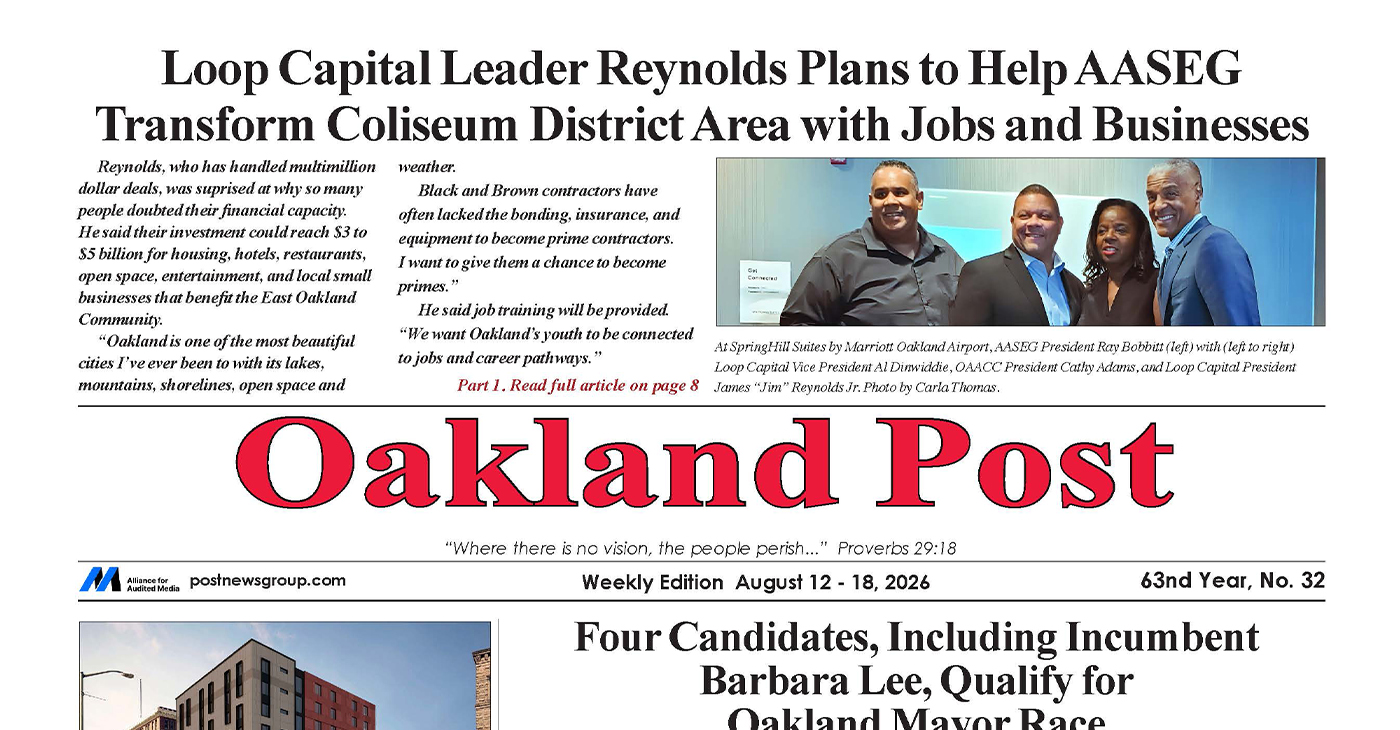
To enlarge your view of this issue, use the slider, magnifying glass icon or full page icon in the lower right corner of the browser window.
Activism
Oakland Post: Week of August 5 – 11, 2026
The printed Weekly Edition of the Oakland Post: Week of August 5 – 11, 2026
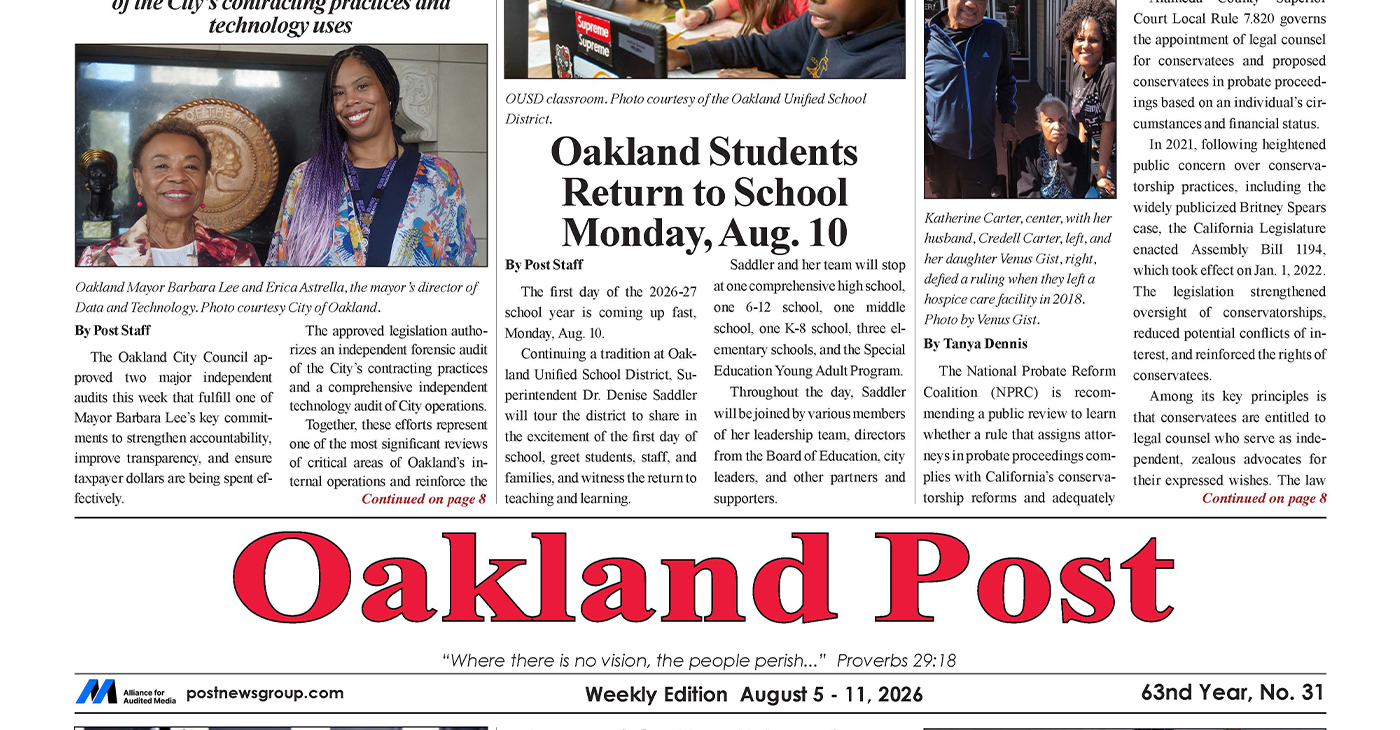
To enlarge your view of this issue, use the slider, magnifying glass icon or full page icon in the lower right corner of the browser window.
Activism
Oakland Post: Week of July 29 – August 4, 2026
The printed Weekly Edition of the Oakland Post: Week of July 29 – August 4, 2026

To enlarge your view of this issue, use the slider, magnifying glass icon or full page icon in the lower right corner of the browser window.

WORK FROM HOME
Home-based business with potential monthly income of $10K+ per month. A proven training system and website provided to maximize business effectiveness. Perfect job to earn side and primary income. Contact Lynne for more details: Lynne4npusa@gmail.com 800-334-0540


Four Candidates, Including Incumbent Barbara Lee, Qualify for Oakland Mayor’s Race

Oakland Observes Black August with Block Parties, Film Showings, Workshops

Oakland Post: Week of August 12 – 18, 2026

COMMENTARY: Why Local School Tax Measure G1 Will Not Be on the November Ballot

California Hispanic Chambers of Commerce Unveils: ‘Powering the Future’ Theme for 47th Annual Statewide Convention

Returning to Its Roots, the Oakland Black-Eyed Pea Festival Partners with the Freedom Farmers Market Sept. 12

Less Affluent School Districts, Including Sacramento City, Face Threat of State Takeover

From Blueprint to Breakthrough: Tackling Affordable Housing in Oakland

NPRC Scores First Advocacy Victory: David Shaw Finally Gets His Wish to ‘Go Home’

ESSAY: California Can Close Its Colorectal Cancer Gap

Car Wash Workers Cope with Lingering Impacts of ICE Raids

Misty Copeland Shapes Ballet’s Tomorrow

As Part of Your Back-to- School Checklist, Vaccinate

As Part of Your Back-to- School Checklist, Vaccinate

Congresswoman Simon Demands Investigation into Trump’s Abuse of Emergency Powers for Coal Export Terminal in West Oakland

Department of Homeland Security Demands California Secretary of State Shirley N. Weber Scrub Voter Rolls

Oakland Children’s Hospital Workers and Patients Rally for Pediatric Medical Care

New Judge Could Decide if Karmelo Anthony Gets a New Trial

“The Power to See Threats Sooner”: Gov. Newsom, Safety Officials Showcase California’s Investments in Hi-Tech Wildfire Prevention

Alpha Kappa Alpha Sorority, Inc. Celebrates New North Atlantic Regional Director

Surveillance Pricing Fight: State Senate Debates Bill Banning Retailers from Using AI to Set Prices Based on a Buyer’s Profile

Mount Zion MBC, Church of Jesus Christ of Latter-day Saints Partner to Bring 29,000 Meals to Alameda County

California Sen. Padilla Joins Colleagues to Introduce Bill Imposing Term Limits on Supreme Court Justices

Starting This Summer, California Car Buyers Can Get an Instant $3500 Off the Cost of Electric Vehicles

COMMENTARY: You Are Already Paying for the AI Boom

California Bill Would Let Abuse Victims Use Trauma as Legal Defense for Violent Crime
Less Affluent School Districts, Including Sacramento City, Face Threat of State Takeover
Car Wash Workers Cope with Lingering Impacts of ICE Raids

Fed Court to Decide Landmark First Amendment Case

Gov. Gavin Newsom Signs Law Streamlining Affordable Housing Rules

The Conversation With Al McFarlane 6/23/26

Media Monday 6/22/26

LIVE! ASK ALMA! — TUES. 6.23.26 7PM EST

Car Buying Secrets: 4 Hidden Checks Before You Sign!

Is This 550 HP Charger Worth YOUR Money? AutoNetwork Review

Celebrating Juneteenth – Frederick Douglass on education and resistance

LIVE! — ASK ALMA! — TUES. 6.19.26 7PM EST

Hyundai Ioniq 5 Parking, Safety, and 360 View #shorts

2025 Ioniq 5 New Wiper & Powerful Performance! #shorts

Electric SUV Range: Is 259 Miles Enough? #shorts

EV Charging: How Fast Can You Charge an Electric Vehicle? #shorts

Biometric Cooling… Messaging Seats…Come on! 2025 Infiniti QX80 Autograph 4WD

Charged Up: Witness the Magic of a Fully Electric Car! #shorts

Range Rover Sport PHEV Included…: See What’s Inside This Luxury SUV! #shorts

Invisible Hood View: Perfect Parking with X-Ray Vision! #shorts
-
 Featured1 week ago
Department of Homeland Security Demands California Secretary of State Shirley N. Weber Scrub Voter Rolls
-
 Business3 weeks ago
Oakland Children’s Hospital Workers and Patients Rally for Pediatric Medical Care
-
 #NNPA BlackPress2 weeks ago
New Judge Could Decide if Karmelo Anthony Gets a New Trial
-
 Environment1 week ago
“The Power to See Threats Sooner”: Gov. Newsom, Safety Officials Showcase California’s Investments in Hi-Tech Wildfire Prevention
-
 Black History2 weeks ago
Alpha Kappa Alpha Sorority, Inc. Celebrates New North Atlantic Regional Director
-
 Business3 weeks ago
Surveillance Pricing Fight: State Senate Debates Bill Banning Retailers from Using AI to Set Prices Based on a Buyer’s Profile
-
 Business3 weeks ago
Mount Zion MBC, Church of Jesus Christ of Latter-day Saints Partner to Bring 29,000 Meals to Alameda County
-
 Featured1 week ago
California Sen. Padilla Joins Colleagues to Introduce Bill Imposing Term Limits on Supreme Court Justices
